If you’ve been told you might have a herniated disc, sciatica, or both, and you’re not sure what the difference actually is, you’re not alone. Patients walk into our Rawalpindi clinic every week describing the same burning, shooting pain down one leg, convinced it’s “just sciatica,” when a closer look shows a disc pressing on a nerve root — or, just as often, something else entirely. Understanding the real relationship in the herniated disc vs sciatica question changes how quickly and how well you recover. In this guide, Dr. Iqra Kiran breaks down what’s actually happening in your spine, the specific tests physiotherapists use to tell these apart, and the treatment approach that gets you moving again without unnecessary surgery in most cases.
Table of Contents
What Is a Herniated Disc?
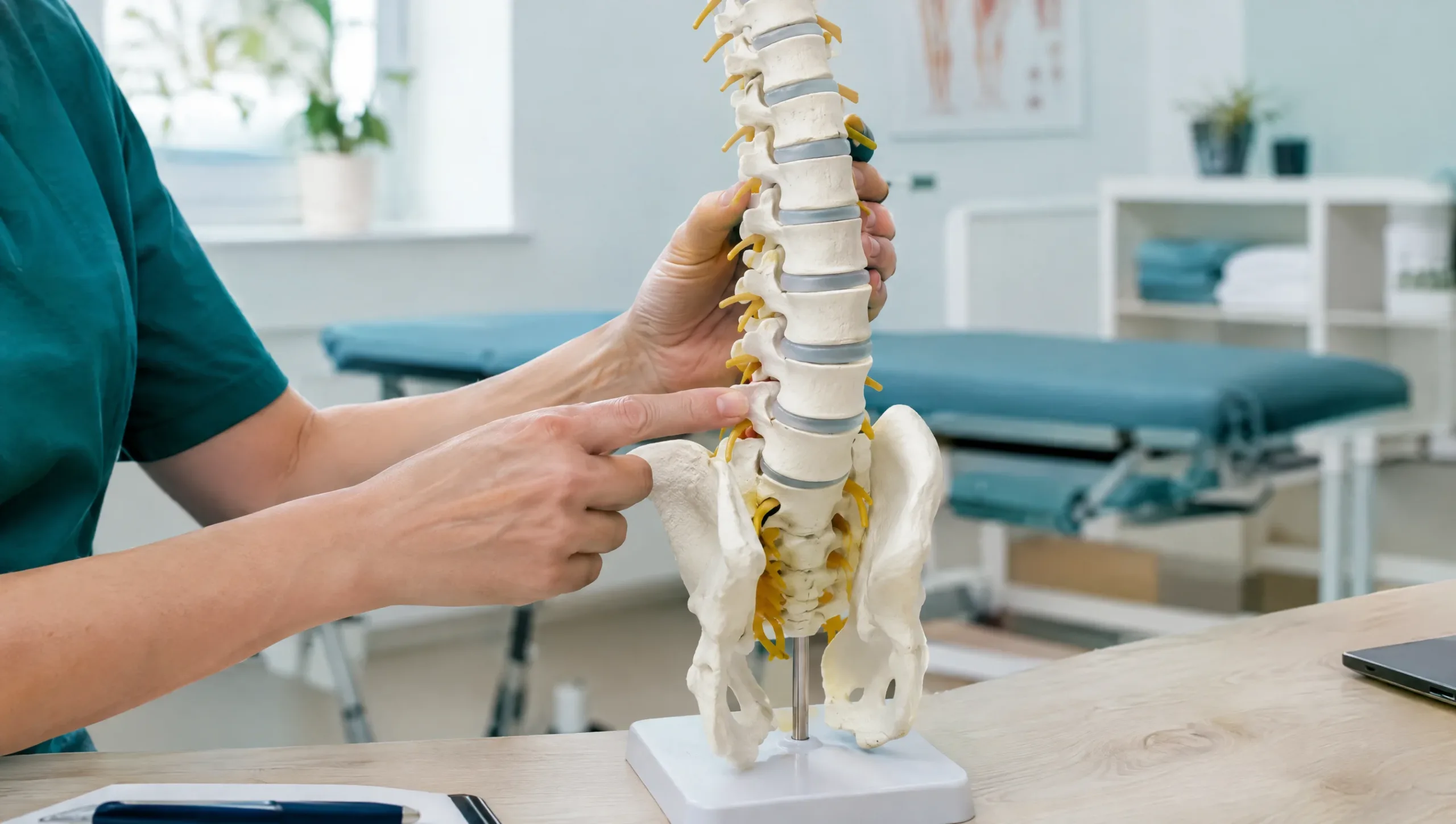
Your spine is built from 33 small bones called vertebrae, cushioned between each level by an intervertebral disc that works like a shock absorber. Each disc has a tough, fibrous outer ring called the annulus fibrosus, wrapped around a soft, gel-like centre called the nucleus pulposus.
A herniated disc happens when that outer ring develops a tear or weak spot, allowing some of the gel-like centre to push outward. If the bulge presses on a nearby spinal nerve root, it can trigger pain, numbness, or weakness that travels well beyond the back itself — often down into the buttock, leg, or foot.
Herniations most commonly occur at the L4-L5 and L5-S1 levels of the lower back, simply because these two segments carry the most load and go through the greatest range of motion during everyday bending and lifting. Common contributing factors include age-related disc degeneration (discs naturally lose water content and elasticity over time), repetitive bending and lifting with poor mechanics, a sudden awkward movement, and genetics.
One thing worth knowing: not every herniated disc causes pain. Imaging studies on people with no back symptoms at all regularly find disc bulges, which is exactly why a physiotherapist never diagnoses purely from a scan — your actual symptoms and movement pattern matter just as much as what shows up on an MRI.
What Is Sciatica, Really?

Here’s the detail that trips most people up: sciatica is a symptom, not a diagnosis. It describes a specific pattern of pain — sharp, burning, or shooting discomfort that travels along the path of the sciatic nerve, the longest and widest nerve in the body, running from the lower back through the buttock and down the back of the leg.
Several different problems can irritate or compress this nerve and produce that same pattern of pain. A herniated disc is one well-known cause, but it is far from the only one. Piriformis syndrome, where a deep hip muscle spasms and presses on the nerve, can mimic disc-related sciatica almost exactly. Spinal stenosis (narrowing of the space around the spinal cord) and spondylolisthesis (one vertebra slipping forward over another) are two more possible culprits.
This is precisely why “I have sciatica” doesn’t actually tell a clinician what structure is at fault. Two people can describe identical pain down the leg and need completely different treatment plans, because the nerve is being irritated by two entirely different problems. For a deeper look at sciatica causes and treatment on its own, our complete guide to sciatica pain and physiotherapy treatment covers it in more depth.
Herniated Disc vs Sciatica: The Key Differences

So let’s put the herniated disc vs sciatica comparison side by side, in plain language, the way we explain it to patients in clinic.
A herniated disc is a structural problem inside the spine — a physical change to the disc itself. Sciatica is a pain pattern that can result from that structural problem, or from something else that has nothing to do with the disc at all. In other words, a herniated disc can exist with or without sciatica, and sciatica can exist with or without a herniated disc.
- Pain behaviour: Disc-related pain typically worsens with sitting, forward bending, coughing, or sneezing, because these movements increase pressure inside the disc. Muscle-related sciatica (such as from the piriformis) tends to worsen with prolonged sitting on a hard surface, climbing stairs, or hip rotation, with bending forward making little difference.
- Pain pattern: True nerve root compression from a disc usually follows a dermatomal pattern — a fairly specific strip running down the leg to a particular part of the foot or toes. Non-disc nerve irritation is often more diffuse, concentrated mainly in the buttock with vaguer leg symptoms.
- Neurological signs: Genuine disc-related nerve root compression can bring measurable changes — a diminished reflex at the knee or ankle, specific muscle weakness (for example, difficulty lifting the big toe upward, which points to the L5 nerve root), or numbness in a precise area. These findings are usually absent when the irritation is coming from a tight muscle rather than the disc itself.
Neither label tells the whole story on its own, which is exactly why a hands-on physiotherapy assessment — not just the word “sciatica” on a referral slip — is what actually determines the right treatment.
How Physiotherapists Diagnose the Difference

A proper assessment starts well before any hands-on testing. We ask exactly where the pain starts and where it travels, what makes it better or worse, whether it came on suddenly or built up gradually, and — importantly — whether there have been any changes in bladder or bowel control (a red flag covered further down).
From there, a few specific physical tests help separate disc-related nerve tension from other causes:
- Straight Leg Raise (SLR) test: With you lying on your back, we slowly lift your straight leg. Pain reproduced down the leg between roughly 30 and 70 degrees of lift is a strong indicator of nerve root tension, often from a disc.
- Slump test: A similar nerve tension test performed in sitting, used to confirm or rule out what the SLR test suggests.
- Neurological screening: We test reflexes at the knee and ankle, muscle strength at specific myotomes, and light-touch sensation across the dermatomes — the precise map of which nerve root supplies which patch of skin and muscle.
- Movement-based assessment: Using a McKenzie-based approach, we check how your pain responds to repeated bending backward versus bending forward. A clear “directional preference” often points toward disc involvement and, usefully, toward the exercises most likely to help.
- Palpation and functional screening: We also check the hip, sacroiliac joint, and deep hip rotator muscles, since piriformis-related or referred hip pain can look remarkably similar to a disc problem on the surface.
Imaging such as an MRI is not needed for every case of back or leg pain. We typically reserve it for red-flag symptoms, cases that aren’t improving after four to six weeks of appropriate conservative care, or before a specialist considers injections or surgery — because, as mentioned above, disc bulges show up on scans of plenty of pain-free people too.
Physiotherapy Treatment for Herniated Discs and Sciatica

The treatment principle is simple to state and genuinely important: we match the plan to the actual driver of your symptoms, not just to the label “sciatica.”
When a disc is the main contributor, treatment usually centres on directional preference exercises (frequently extension-biased, following a McKenzie-based protocol), gentle lumbar traction to temporarily reduce pressure on the nerve root, and progressive core and deep stabilizer strengthening — particularly the transverse abdominis and multifidus muscles that support the spine from the inside out. Postural correction matters enormously here too, especially for the many desk-based professionals we see in Rawalpindi and Islamabad who spend eight-plus hours a day in sustained flexion.
When the sciatica is coming from somewhere other than the disc — the piriformis muscle, for example — the approach looks different: targeted stretching and release of the tight muscle, hip and gluteal strengthening, and correction of walking or movement patterns that keep overloading that muscle.
Across both presentations, neural mobilization (“nerve flossing”) techniques are often used to gently restore normal nerve gliding and reduce sensitivity, alongside manual therapy to improve joint mobility and a graded return to normal activity and exercise. Major health institutions, including the Mayo Clinic’s guidance on herniated disc treatment, confirm that most people improve with conservative, non-surgical care given enough time and the right exercise programme.
One honest caveat: this article is general education, not a diagnosis. If your pain is severe, rapidly worsening, or involves any of the red-flag symptoms below, please get an in-person assessment before starting any exercise programme on your own.
When to See a Doctor Immediately (Red Flags)
Most cases that fall under the herniated disc vs sciatica umbrella are very manageable with physiotherapy and respond well over a few weeks. But a small number of symptoms point to something more urgent and need immediate medical attention rather than a physiotherapy appointment:
- Loss of bladder or bowel control, or new difficulty starting urination
- Numbness in the “saddle” area — the inner thighs, groin, or around the genitals
- Progressive weakness affecting both legs, not just one
- Unexplained weight loss or fever occurring alongside back pain
- Severe pain following significant trauma, such as a fall or road accident
Together, the first three can signal cauda equina syndrome, a rare but genuine medical emergency that requires urgent hospital assessment, sometimes within hours. If any of these apply to you, please go to an emergency department rather than waiting for a routine appointment.
Once your pain has settled, a few practical habits go a long way toward keeping it that way. If you spend long hours at a desk — extremely common among the IT professionals and office workers we see across Rawalpindi and Islamabad — set a reminder to stand and walk for two to three minutes every 30 to 45 minutes, since sustained sitting is one of the biggest loading factors for the lower discs. When lifting anything from the floor, bend at the hips and knees rather than rounding through the lower back, and keep heavy objects close to your body rather than reaching out with straight arms. Building a baseline of core and hip strength through a consistent, physiotherapist-guided programme also reduces how much load your discs absorb during everyday bending and twisting. None of these habits are complicated, but consistency matters far more than intensity here.
Frequently Asked Questions

Can a herniated disc heal on its own without surgery?
In most cases, yes. The majority of herniated discs improve over time with conservative care, including physiotherapy, activity modification, and anti-inflammatory management, and many bulges actually shrink in size as the body gradually reabsorbs the herniated material. Surgery is generally reserved for cases with significant ongoing nerve damage, uncontrolled pain, or the red-flag symptoms described above.
How long does sciatica from a herniated disc usually last?
Most people notice meaningful improvement within four to six weeks of starting appropriate physiotherapy, though full resolution can take three months or longer depending on the size of the herniation and how early treatment begins. Sciatica that lingers well past three months without improvement, or keeps returning, usually needs a more thorough reassessment of both the diagnosis and the treatment plan.
Can I keep exercising with a herniated disc?
Usually, yes, with some modification. Complete bed rest is no longer recommended for disc-related back pain since it tends to slow recovery rather than help it. What’s generally best avoided early on is loaded spinal flexion, such as heavy deadlifts, sit-ups, or toe-touches, along with high-impact activity, until a physiotherapist confirms the disc has stabilized. Walking, modified core work, and directional exercises matched to your specific presentation are usually encouraged from early on.
Is walking good or bad for sciatica caused by a disc problem?
For most people, walking genuinely helps. It encourages blood flow, keeps the spine mobile, and rarely aggravates true disc-related sciatica the way prolonged sitting often does. The exception is if walking itself clearly increases leg pain or numbness; in that case, it is worth having a physiotherapist check whether a different approach is needed before pushing through it.
For more general questions about our clinic and services, visit our FAQs page or our Physiotherapy FAQ: Expert Answers page.
Living with ongoing back or leg pain and not sure whether you’re dealing with a herniated disc, sciatica, or both? Dr. Iqra Kiran and the team at Physio Rehab Solution in Rawalpindi can give you a clear, hands-on assessment and a treatment plan built around your specific presentation, not just a generic label. Book an in-person appointment at our Rawalpindi clinic by calling +92 321 4287773 today.