By Dr. Iqra Kiran, DPT
If you’ve just been told you have Bell’s palsy, you’ve probably already heard two conflicting things: that it usually gets better on its own, and that physiotherapy with facial exercises can help you recover faster. So which is it? This guide looks at what the research actually says about facial exercises for Bell’s palsy, when to start them, which ones physiotherapists use, and the mistakes that can quietly slow down a nerve that’s already trying to heal.
We’ll cover what’s actually proven, what’s still debated among clinicians, and the practical details — like how often to exercise and what to avoid — that tend to get left out of shorter overviews.
Table of Contents
- Understanding Bell’s Palsy and Why Recovery Timing Matters
- Do Facial Exercises Actually Speed Up Bell’s Palsy Recovery? What the Evidence Shows
- When Should You Start Facial Exercises After a Bell’s Palsy Diagnosis?
- Facial Exercises for Bell’s Palsy: What Physiotherapists Actually Recommend
- Mistakes That Can Slow Down Facial Nerve Recovery
- How Long Does Bell’s Palsy Recovery Usually Take With Physiotherapy?
- Frequently Asked Questions
Understanding Bell’s Palsy and Why Recovery Timing Matters
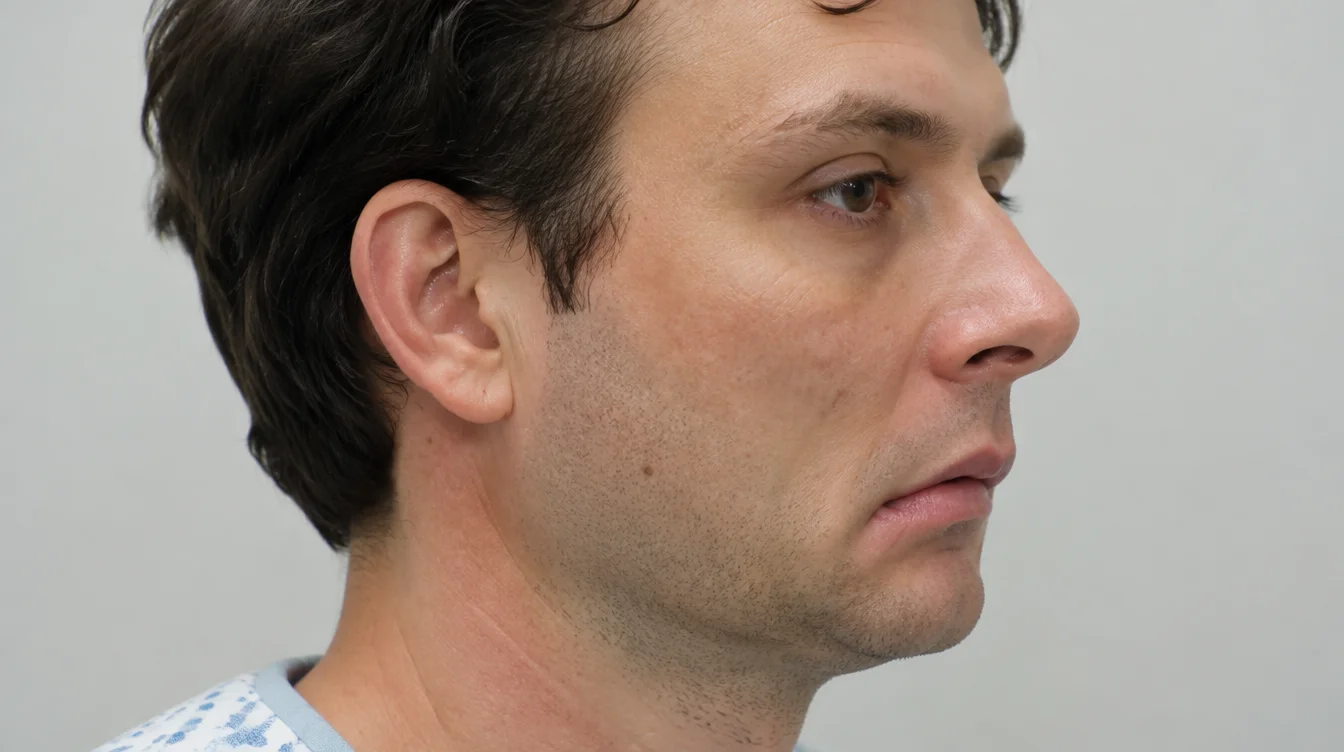
Bell’s palsy is a sudden, temporary weakness or paralysis of the muscles on one side of the face, caused by inflammation or compression of the facial nerve (cranial nerve VII). It typically comes on over a few hours to a couple of days: one side of the mouth droops, the eye on that side may not close properly, and some people lose the ability to taste on the front of the tongue or become sensitive to sound in one ear.
The exact trigger isn’t always clear, though a viral link (often to the herpes simplex virus) is the leading theory. The important first step, before any exercise program, is a proper medical diagnosis. Sudden one-sided facial weakness can occasionally signal a stroke rather than Bell’s palsy, and only a doctor can rule that out with a physical exam and, if needed, imaging.
Once Bell’s palsy is confirmed, timing becomes the central question. Most people recover a meaningful amount of function within three weeks, and roughly seven in ten recover fully without any lasting weakness. But a smaller group develops longer-term problems: persistent weakness, abnormal nerve regrowth (synkinesis, where the eye and mouth move together involuntarily), or facial muscle tightness. This is exactly where physiotherapy, and in particular supervised facial exercises, has the most to offer.
House-Brackmann and similar grading systems are what most physiotherapists and ENT specialists use to classify severity, running from mild weakness to total paralysis. Where you fall on that scale at diagnosis is one of the strongest predictors of how long recovery will take and whether facial exercises are likely to make a meaningful difference versus the condition simply resolving on its own. Someone with mild, partial weakness has a very high chance of full spontaneous recovery regardless of exercise; someone with complete paralysis has more to gain from a structured program, and more risk of long-term complications if retraining is skipped.
It’s also worth understanding why timing is discussed so much in Bell’s palsy literature specifically, compared to other causes of facial weakness. The facial nerve travels through a narrow bony canal in the skull before reaching the muscles of the face. When it swells from inflammation, it can become compressed within that canal, and the longer significant compression persists, the greater the risk that nerve fibers are damaged rather than just temporarily blocked. This is the biological reason doctors emphasize starting corticosteroids quickly, and it’s also why physiotherapy is framed as a recovery-phase tool rather than something that changes the initial injury itself.
Do Facial Exercises Actually Speed Up Bell’s Palsy Recovery? What the Evidence Shows

This is the question worth answering honestly rather than optimistically. The evidence doesn’t say facial exercises are a guaranteed fast-track to recovery, but it does point to a real, specific benefit: well-timed, correctly performed facial exercises appear to reduce the risk of long-term complications, particularly synkinesis and persistent muscle tightness, more than they dramatically shorten the overall recovery timeline.
Systematic reviews of physical therapy for Bell’s palsy, including work summarized by the National Institute of Neurological Disorders and Stroke, describe facial neuromuscular retraining as a reasonable adjunct to medical treatment (usually corticosteroids started early) rather than a replacement for it. The mechanism is believable: structured, mirror-guided facial movements give the regenerating nerve fibers better “practice” at reconnecting to the correct muscles, which is thought to lower the odds of the miswiring that causes synkinesis.
What the research is less convinced about is whether exercises started too early, or done too aggressively, actually help. Several studies have flagged that intense, high-repetition facial exercise in the first couple of weeks after onset may do more harm than good by overworking a nerve that’s still acutely inflamed. That nuance, more than the headline “do exercises work,” is what should shape your actual program.
A frequently cited Cochrane-style review pattern in facial palsy rehabilitation research is this: trials comparing “exercise plus standard care” against “standard care alone” tend to show improvement in facial symmetry and patient-reported outcomes, but the studies are often small, use different exercise protocols, and don’t always agree on exactly how much benefit to expect. That’s a meaningfully different claim from “exercises cure Bell’s palsy faster,” and it’s why most reputable sources describe the evidence as moderate and supportive rather than definitive.
In practical terms, this means facial exercises are worth doing, under guidance, but they should be presented honestly: as a way to improve the quality of your recovery and reduce complication risk, not as a guaranteed way to shorten how many weeks or months the condition lasts.
When Should You Start Facial Exercises After a Bell’s Palsy Diagnosis?

Most physiotherapists distinguish between the acute phase (roughly the first 10-14 days) and the recovery phase that follows. In the acute phase, the priority is usually gentle care, not vigorous exercise: protecting the eye if it isn’t closing fully, keeping facial muscles relaxed, and light self-massage rather than forceful movement.
Active facial exercises are generally introduced once early signs of movement return, or around the two-to-three-week mark if weakness is still complete, and always alongside whatever your doctor has prescribed (commonly a short course of corticosteroids, which work best started within 72 hours of symptom onset). This is a case where “more, sooner” is not automatically better, and a physiotherapist experienced in facial palsy will usually assess your specific pattern of weakness before prescribing anything.
If you’re more than a few weeks out and movement still hasn’t started to return, that’s also a reason to be reassessed rather than to simply keep waiting, since a small number of cases need a different diagnosis or a different treatment approach entirely.
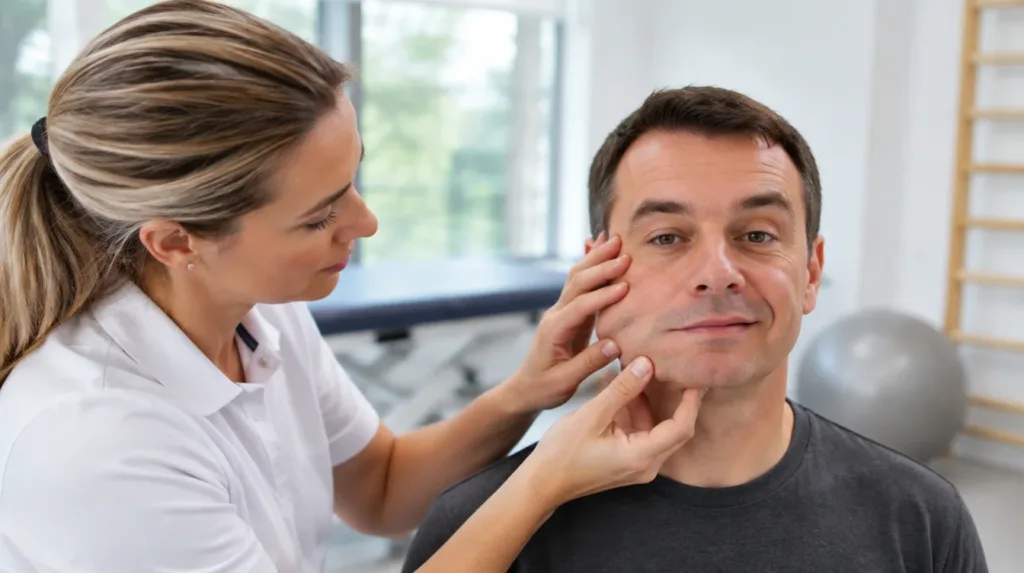
Self-massage is often introduced earlier than active exercise, even during the acute phase, because gentle massage doesn’t load the nerve the way active muscle contraction does. Warm (not hot) compresses followed by soft, circular massage along the jaw, cheek, and forehead can help with comfort and may reduce stiffness that builds up while muscles are weak or still. This is a reasonable starting point while you wait for the green light on active exercises from your physiotherapist.
Facial Exercises for Bell’s Palsy: What Physiotherapists Actually Recommend

From Dr. Iqra’s Clinic
[PLACEHOLDER — Dr. Iqra: replace this with a real, anonymised patient example or clinical observation about Bell’s palsy facial exercise recovery before publishing. Delete this box if not used.]
Once you’re cleared to begin, facial neuromuscular retraining is typically done in front of a mirror, slowly and with control, rather than quickly or with maximum effort. Common exercises physiotherapists use include:
- Gentle brow raises and frown practice, watching for symmetry rather than range.
- Controlled eye closure, closing both eyes softly together and checking the affected side keeps pace with the unaffected one.
- Cheek puffing and lip pursing (as if whistling or blowing out a candle) to retrain the muscles around the mouth.
- Small, symmetrical smiles rather than a full wide smile, which tends to over-recruit the stronger side.
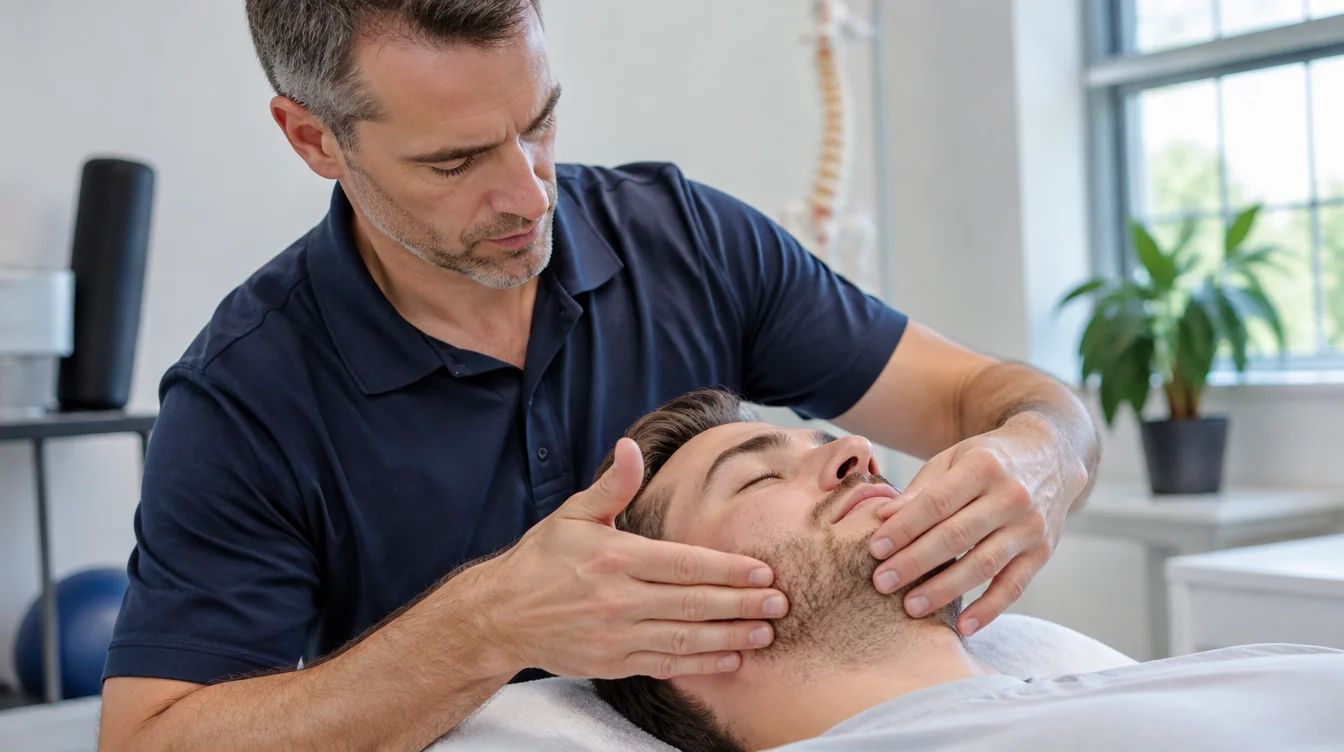
- Soft tissue massage and gentle stretching of tight areas, often paired with warm compresses before the exercise set.
Sessions are usually short, 10-15 minutes, done once or twice a day, several days a week, rather than long or exhausting. A physiotherapist will usually track your progress with a standardized facial grading scale rather than relying on how things “look” from one week to the next, since early changes can be subtle.
Two details matter more than most people expect. First, mirror feedback isn’t optional — doing these exercises without watching your face closely makes it very easy to unconsciously compensate with the stronger side, which defeats the purpose of the retraining. Second, consistency beats intensity: a short, calm, well-performed session twice a day, every day, outperforms an occasional long session done with effort and frustration.
Some physiotherapists also incorporate light taping or kinesiology tape to give sensory feedback and gently support the drooping side between sessions, though this is usually an adjunct rather than a core part of the program, and not every case needs it.
Mistakes That Can Slow Down Facial Nerve Recovery
A handful of habits show up repeatedly in people whose recovery stalls or who develop synkinesis, and most of them come from good intentions.
Exercising too hard, too soon. Trying to force a big smile or wide eye opening while the nerve is still acutely inflamed can encourage the wrong muscle fibers to fire together, which is a known contributor to synkinesis later on.
Skipping eye protection. If the eyelid isn’t closing fully, the cornea can dry out and become irritated or scratched, which is painful and entirely preventable with lubricating drops and taping at night, as advised by your doctor.
Comparing week-to-week progress to someone else’s recovery. Bell’s palsy recovery is genuinely variable: some people see change in days, others in months, and comparing timelines (including to stories online) tends to create unnecessary anxiety rather than useful information.
Stopping exercises the moment movement returns. Early return of movement is encouraging, but it’s often when retraining matters most, since this is the window where the nerve is “deciding” which pathways to reinforce.
Ignoring the non-facial symptoms. Dry eye, altered taste, and sound sensitivity are often temporary, but ignoring them (especially dry eye) can create a second problem on top of the original one, so they’re worth managing actively rather than waiting out.
Doing exercises without any professional check-in. Self-directed exercise from a generic handout, without anyone checking your technique or grading your progress, makes it harder to catch early signs of synkinesis — which is most manageable when caught and addressed early, rather than months later.
How Long Does Bell’s Palsy Recovery Usually Take With Physiotherapy?

For the majority of people, noticeable improvement begins within two to three weeks, with most of the recovery happening over three to six months. Complete recovery, including fine control and symmetry, can take up to a year in a smaller subset of cases, particularly where the initial weakness was total rather than partial.
Physiotherapy doesn’t reliably compress this overall timeline for everyone, and you should be cautious of anything promising a guaranteed number of weeks. What a structured facial exercise program is more consistently associated with is a better end result: less residual tightness, less involuntary movement, and a more symmetrical resting face, especially for people whose initial weakness was more severe.
If you’re past six months with little to no improvement, that’s a reasonable point to ask your doctor or physiotherapist about further assessment, since a minority of cases benefit from additional interventions beyond standard exercise therapy.
Age, severity at onset, and how quickly treatment started all influence this timeline. Younger patients and those with partial (rather than complete) weakness at diagnosis tend to recover faster and more completely. This is one more reason an individualized assessment matters more than a generic recovery calendar.
Frequently Asked Questions

Can facial exercises make Bell’s palsy worse?
Done gently and at the right stage, no — but forceful, high-effort exercises started too early in the acute phase have been associated with a higher risk of synkinesis. This is why most physiotherapists start with gentle, controlled movement rather than maximum-effort repetitions.
Should I use electrical stimulation for Bell’s palsy?
Routine electrical stimulation is generally not recommended for Bell’s palsy, as several studies have found it offers no clear benefit over exercise alone and may, in some cases, increase the risk of abnormal muscle patterning. Most current physiotherapy guidance favors mirror-based neuromuscular retraining instead.
How do I know if my Bell’s palsy exercises are working?
Rather than relying on how your face looks day to day, a physiotherapist experienced in facial palsy can track your progress using a standardized grading scale at each visit, which picks up small, meaningful changes that are easy to miss when you’re looking in the mirror every day.
Is Bell’s palsy permanent?
For most people, no — roughly 70% recover fully. A minority are left with some residual weakness, tightness, or synkinesis, which is precisely the group that tends to benefit most from a structured, professionally guided facial exercise program.
Can I do facial exercises for Bell’s palsy without seeing a physiotherapist first?
Gentle self-massage and basic eye care are reasonable to start on your own alongside your doctor’s advice, but active, targeted facial exercises are best learned from a physiotherapist experienced in facial palsy, since incorrect technique in the early weeks is one of the more avoidable contributors to synkinesis.
Facial exercises are not a magic shortcut for Bell’s palsy, but when they’re introduced at the right time, guided by someone who understands facial nerve recovery, and done with control rather than force, they are one of the few things within your control that meaningfully improves your long-term outcome. If you’re dealing with new or ongoing facial weakness, it’s worth having it assessed in person by a licensed physiotherapist or doctor near you rather than guessing from general information online.
For related reading, see our guide to physiotherapy for nerve-related conditions like diabetic neuropathy, or browse more answers in our physiotherapy FAQ.