If you feel a dull ache or stiffness at the back of your heel every morning, or a sharp pinch in your Achilles tendon the moment you start a run, you are not imagining it. Achilles tendinitis is one of the most common overuse injuries we see at Physio Rehab Solution in Rawalpindi, especially among runners, badminton and cricket players, and people who have recently increased their walking or gym routine. The good news is that achilles tendinitis physiotherapy treatment is highly effective for the vast majority of patients, and most people recover full function without surgery when they start the right rehabilitation program early.
In this guide, we will walk through what Achilles tendinitis actually is, why it develops, how a physiotherapist diagnoses it, and exactly what a structured recovery plan looks like, week by week. This article is for general education and is not a substitute for an in-person assessment, so if your pain is severe, sudden, or came with a “pop” sound, please get examined by a physiotherapist or doctor before trying anything below.
Table of Contents
- What Is Achilles Tendinitis?
- Causes and Risk Factors in Rawalpindi’s Active Population
- Signs and Symptoms You Shouldn’t Ignore
- How Physiotherapists Diagnose Achilles Tendinitis
- Achilles Tendinitis Physiotherapy Treatment: What Actually Works
- Recovery Timeline: What to Expect Week by Week
- Safe At-Home Exercises to Support Your Recovery
- Frequently Asked Questions
What Is Achilles Tendinitis?
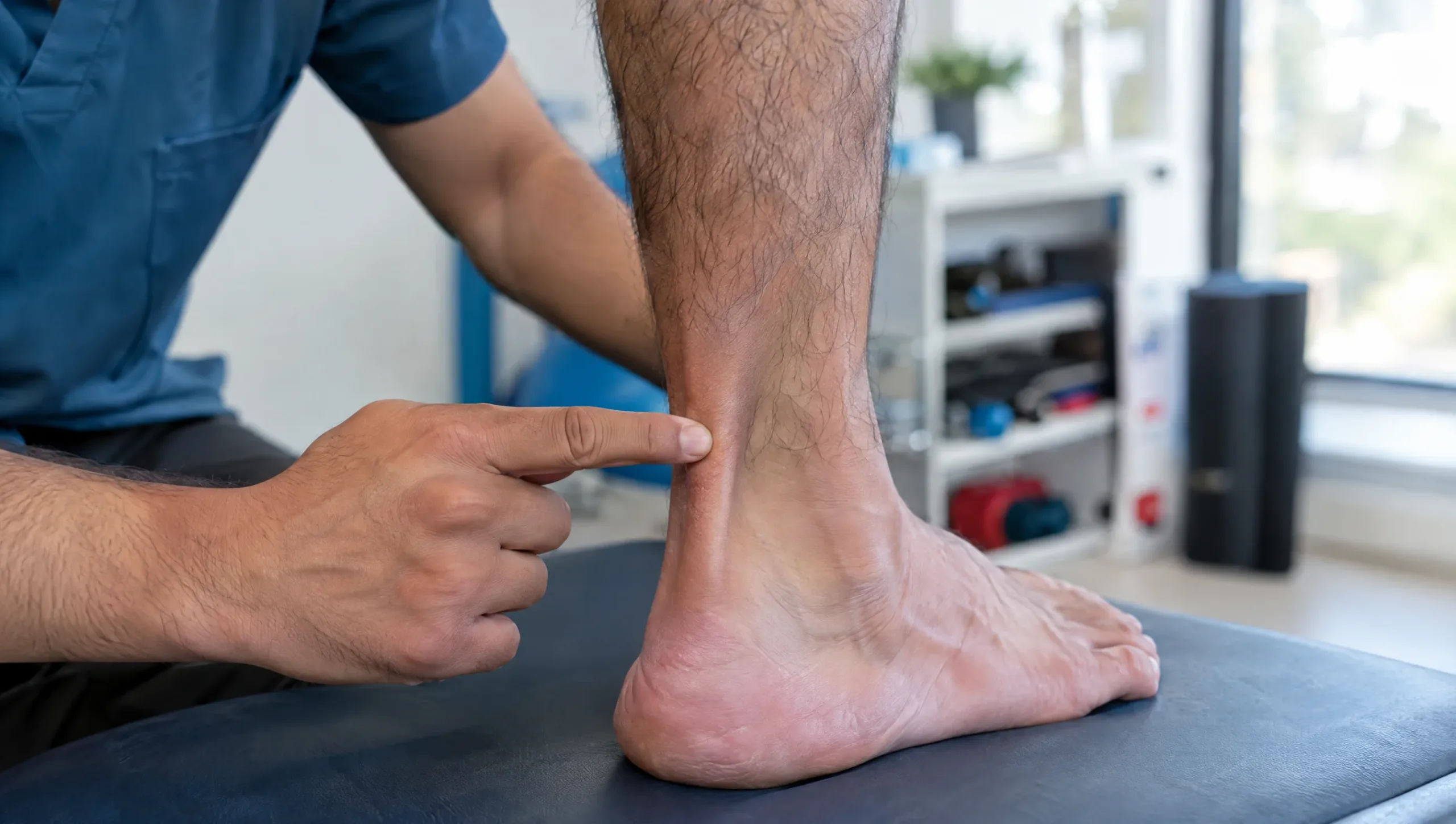
The Achilles tendon is the thick band of tissue connecting your calf muscles to your heel bone. It is the strongest tendon in the human body, but it is also one of the most overworked, absorbing forces several times your body weight every time you push off the ground while walking, running, or jumping.
Achilles tendinitis happens when this tendon becomes irritated and inflamed, usually from repetitive strain rather than a single traumatic event. In physiotherapy, we now understand most chronic cases are better described as “tendinopathy,” meaning the tendon tissue itself has started to degenerate at a microscopic level rather than staying simply inflamed. This distinction matters because it changes how we treat it: true tendinopathy responds best to progressive loading exercises, not just rest and ice.
There are two common types. Mid-substance Achilles tendinitis affects the tendon roughly two to six centimetres above the heel, and is the type runners develop most often. Insertional Achilles tendinitis affects the point where the tendon attaches to the heel bone itself, and tends to respond a little more slowly to treatment.
Causes and Risk Factors in Rawalpindi’s Active Population
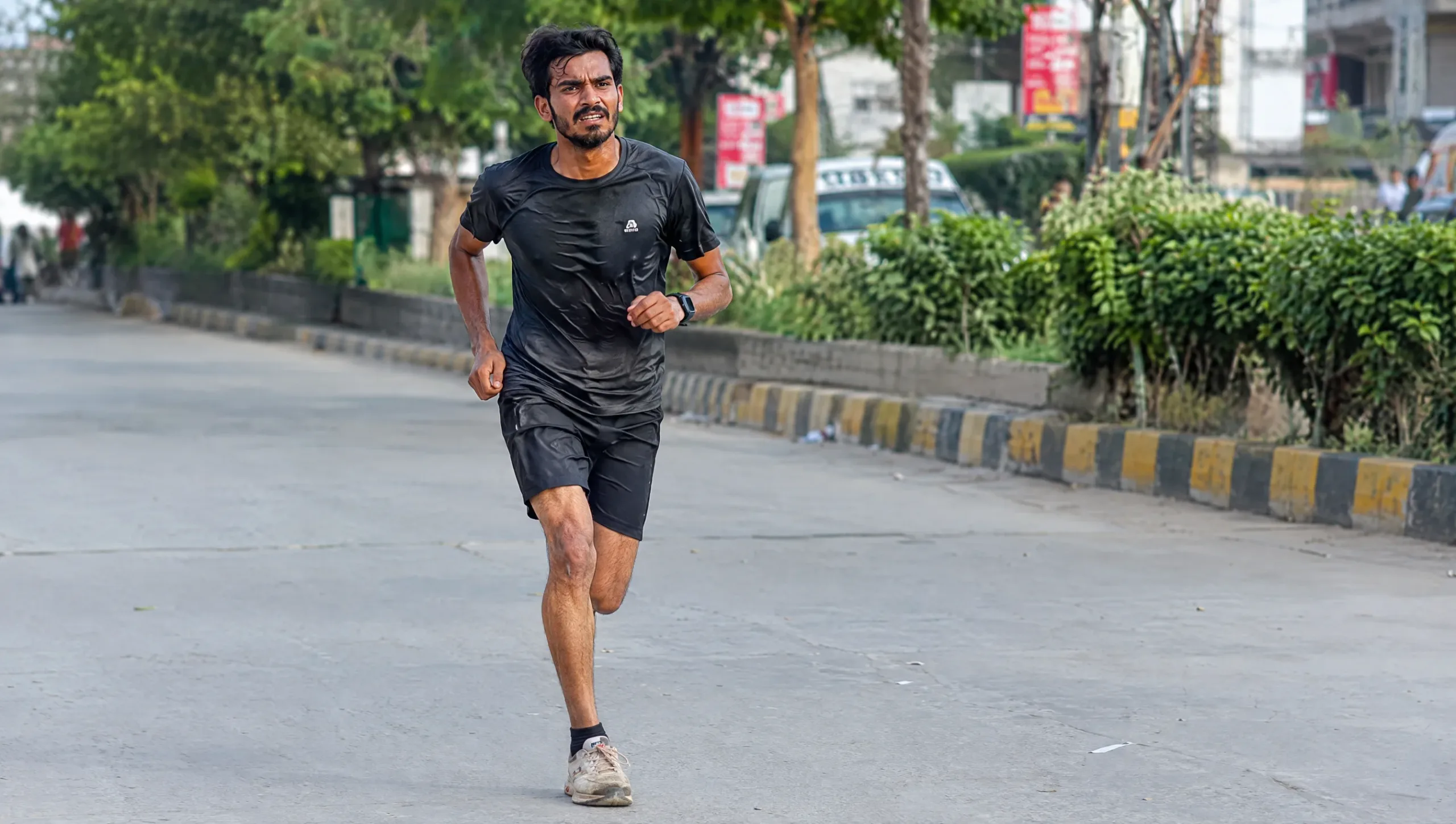
Achilles tendinitis is almost always a “too much, too soon” injury. We see it most frequently in a few specific patterns among our patients in Rawalpindi and Islamabad.
Runners and walkers who suddenly increase distance, speed, or hill training without a gradual build-up are at high risk, especially if they have recently switched to minimalist or worn-out running shoes. Badminton, squash, and cricket players who do a lot of quick starts and direction changes on hard indoor courts also place repeated strain on the tendon.
Tight calf muscles and a stiff ankle joint are common contributing factors, as is a sudden return to activity after weeks of inactivity, which many of our patients experience after Ramadan, after an illness, or after a desk-bound work period. Flat feet or very high arches change how load travels through the tendon, and being over 40 matters too, since tendons naturally lose some of their elasticity and blood supply with age.
Certain medications, particularly fluoroquinolone antibiotics, are also recognised as a risk factor for tendon problems and should be flagged to your doctor if you develop sudden tendon pain while taking them. Carrying extra body weight increases the load the tendon absorbs with every step, and training exclusively on hard, unforgiving surfaces such as concrete pavements, without ever varying terrain, can accelerate wear on the tendon over months of repeated impact.
Signs and Symptoms You Shouldn’t Ignore
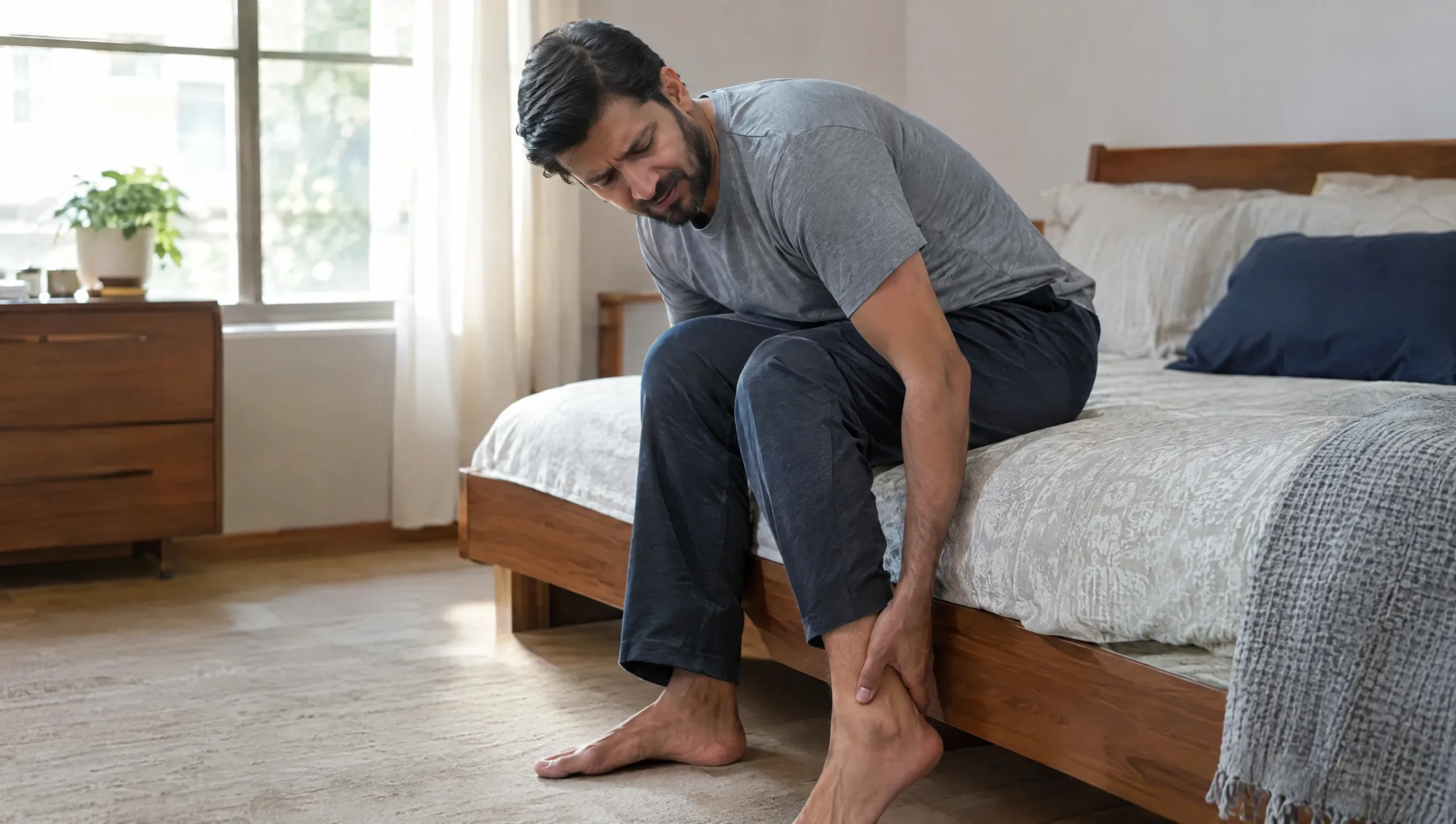
The most common early symptom is a dull, aching stiffness along the back of the heel or lower calf that is worse first thing in the morning or after sitting for a long time, and that tends to ease slightly once you warm up, only to return after activity.
As it progresses, you may notice tenderness when you squeeze the sides of the tendon, mild swelling or thickening along the tendon, and a creaking or crackling sensation (called crepitus) when you move your ankle. Pain that increases the day after exercise, rather than during it, is a classic pattern.
One symptom deserves immediate medical attention rather than a physiotherapy appointment: a sudden, sharp pain described as being “kicked” or “shot” in the back of the leg, often with an audible pop and an inability to rise onto your toes. This can indicate a partial or complete Achilles tendon rupture, and needs urgent assessment at a hospital, not home exercises.
How Physiotherapists Diagnose Achilles Tendinitis
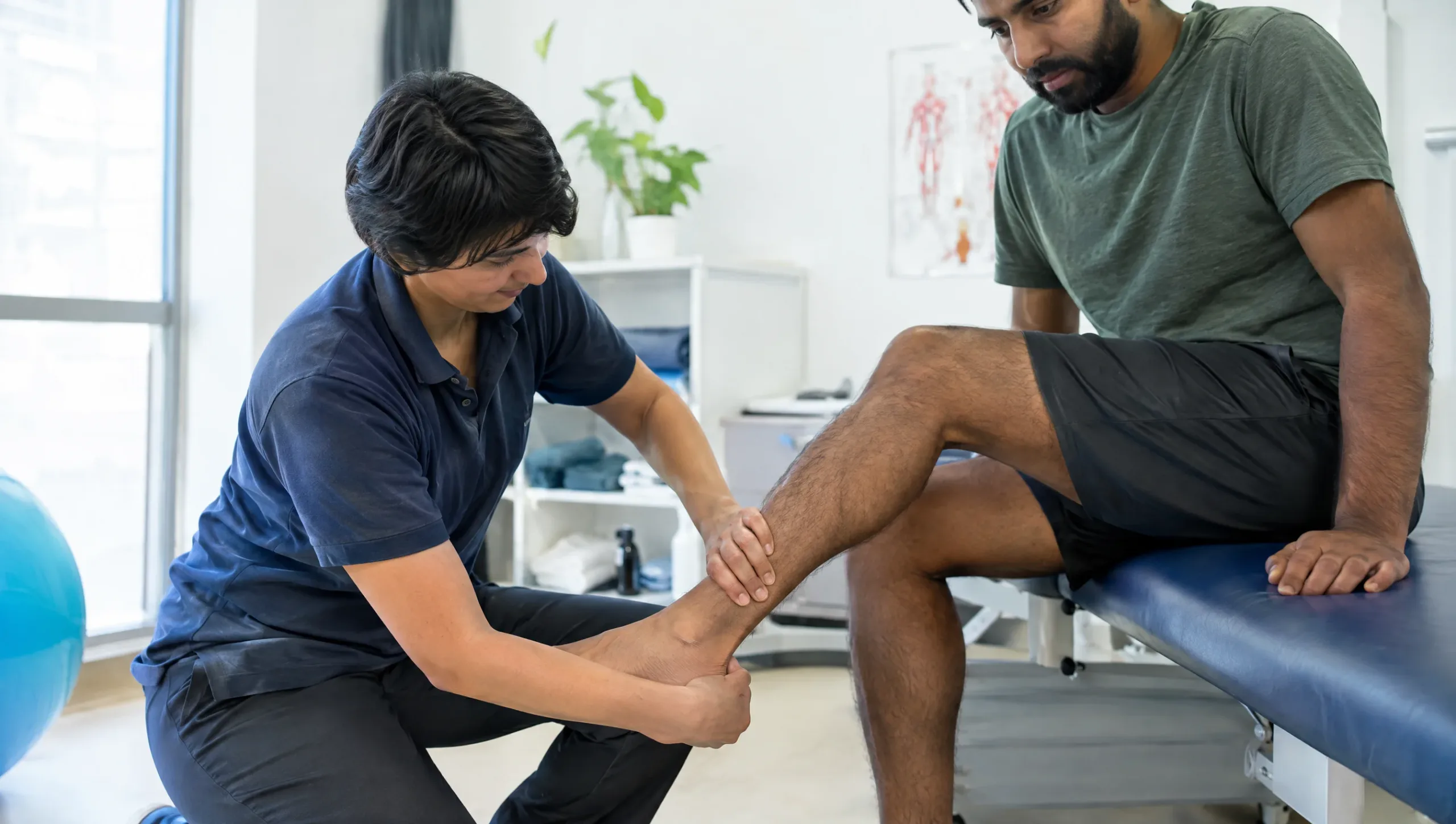
Diagnosis usually starts with a detailed history: when the pain began, what activity changes preceded it, and exactly where along the tendon it hurts. This alone tells an experienced physiotherapist a great deal about whether this is mid-substance or insertional tendinopathy.
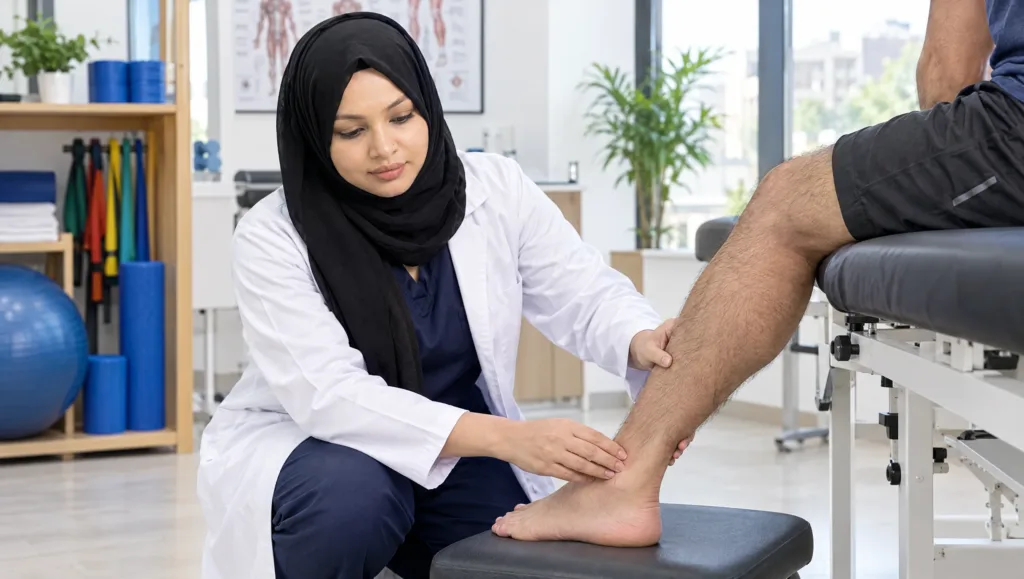
From there, we perform a hands-on examination, feeling along the length of the tendon for thickening, nodules, or specific points of tenderness, and checking ankle range of motion and calf flexibility on both sides for comparison. Functional tests, such as single-leg heel raises, help reveal how much strength and load tolerance has already been lost, and a test called the Royal London Hospital test helps distinguish tendinopathy from other causes of heel and ankle pain.
In most straightforward cases, imaging is not required to begin treatment. However, if symptoms do not improve after a reasonable trial of physiotherapy, or if a rupture is suspected, an ultrasound or MRI may be recommended to look at the internal structure of the tendon. According to Mayo Clinic’s overview of Achilles tendinitis, most cases do respond well to conservative, non-surgical care when addressed early, which is consistent with what we see clinically.
Achilles Tendinitis Physiotherapy Treatment: What Actually Works
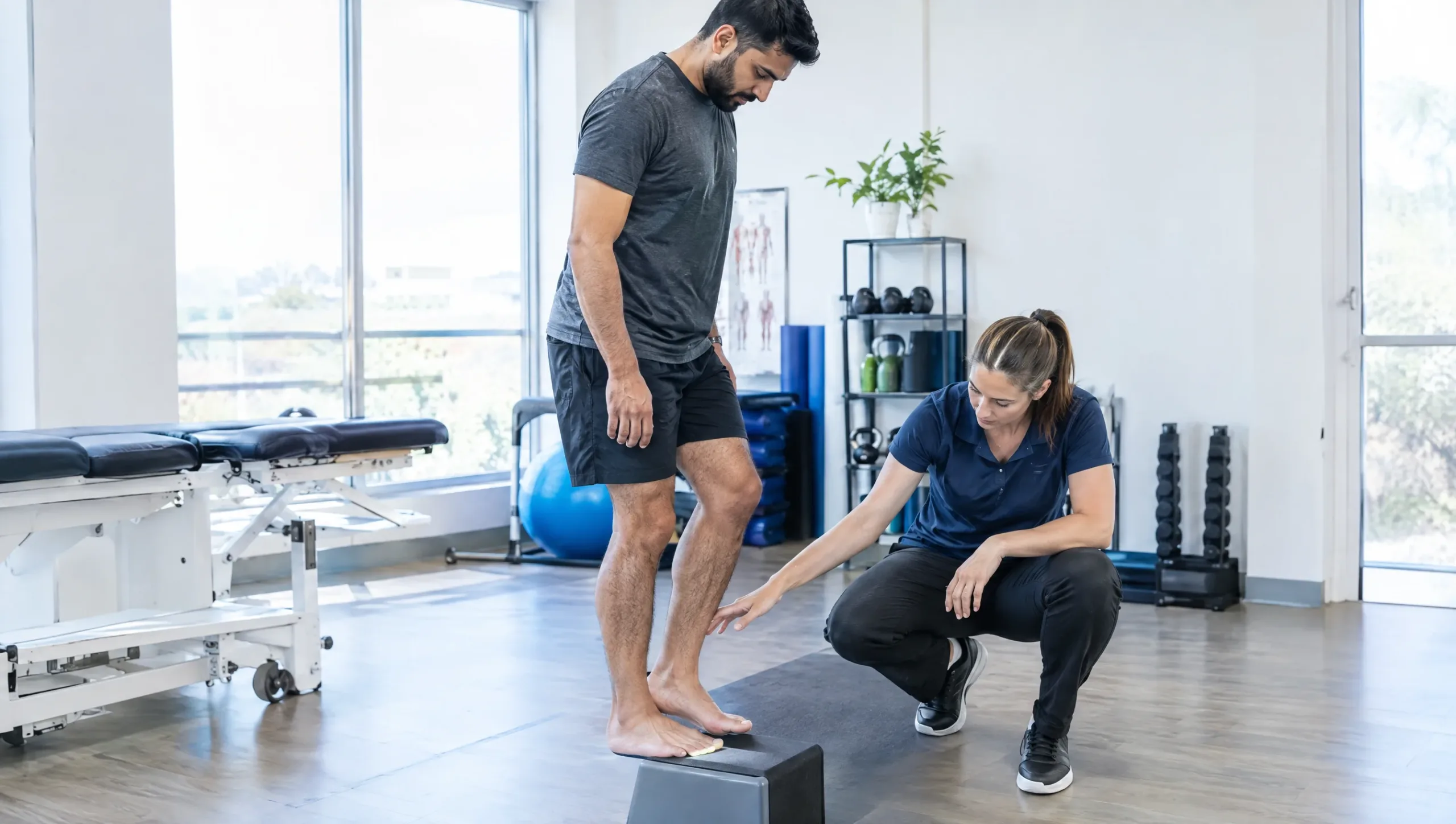
Modern achilles tendinitis physiotherapy treatment has moved well past “rest and ice alone,” because research consistently shows that tendons need controlled loading to heal properly, not just time off. Our approach at Physio Rehab Solution typically combines several elements.
The first phase focuses on calming irritated tissue. This may include activity modification rather than complete rest, gentle manual therapy to the calf and ankle, taping or temporary heel lifts to offload the tendon, and ice after aggravating activity. We rarely recommend total immobilisation, since prolonged rest alone tends to weaken the tendon further and delays recovery.
The second and most important phase is progressive loading, usually beginning with isometric holds (pressing against resistance without moving the ankle), which can reduce pain quickly while maintaining strength. From there, we progress to eccentric heel-drop exercises, which have the strongest research backing for tendinopathy recovery, followed by heavier, slower strength training and eventually plyometric or running-specific drills once strength and pain allow.
Manual therapy techniques such as soft tissue release and joint mobilisation help restore ankle flexibility, while dry needling is sometimes used for persistent muscle tightness in the calf. Gait and running technique analysis is particularly useful for our runner patients, since a small change in cadence or foot strike pattern can meaningfully reduce tendon load going forward. Throughout, we track your tolerance with simple pain-monitoring rules, since some discomfort during loading exercises is expected and safe, while sharp or worsening pain is a sign to scale back.
Recovery Timeline: What to Expect Week by Week
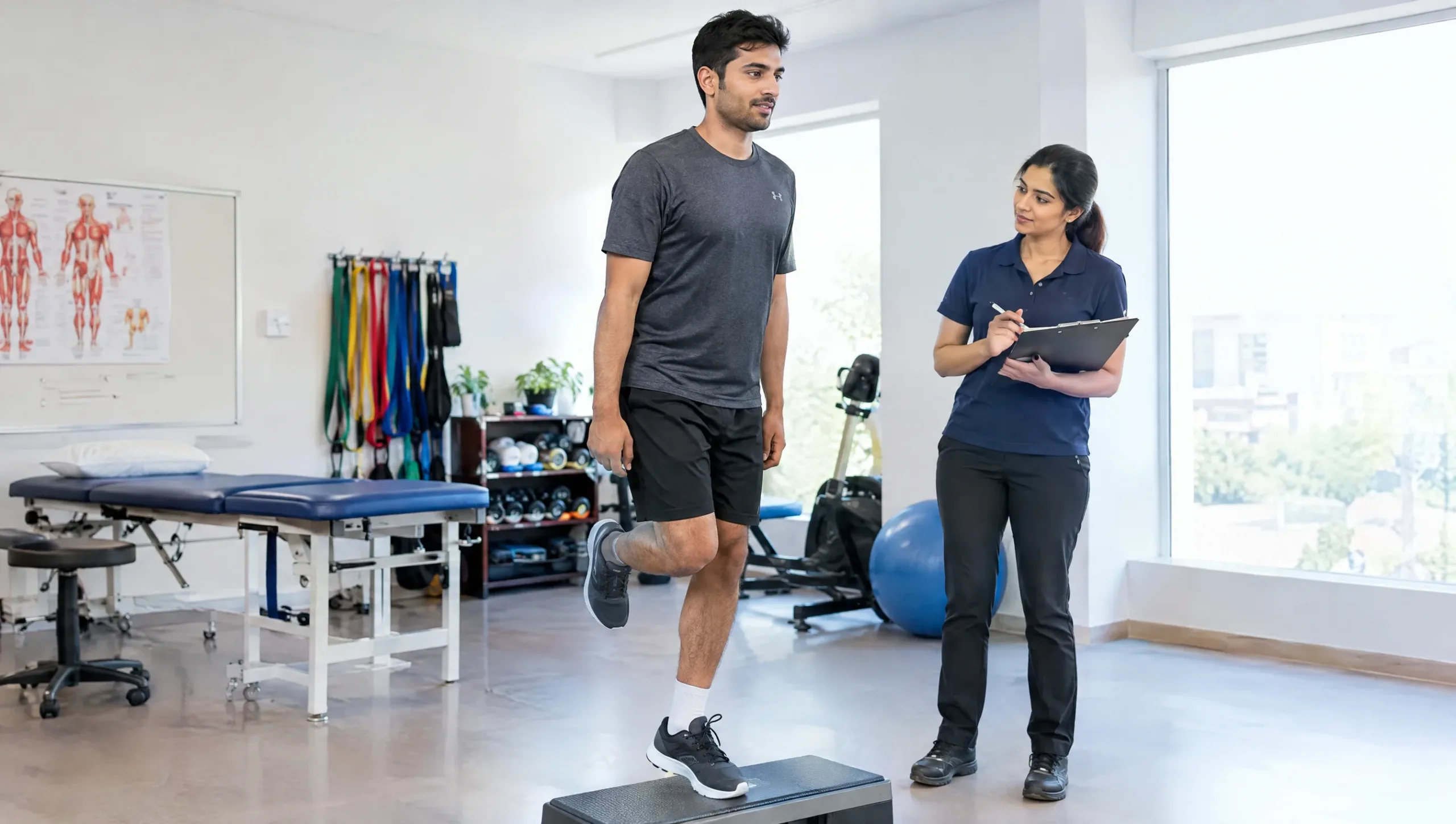
Every patient heals at a different pace depending on how long symptoms were present before treatment began, but most of our patients follow a broadly similar arc.
In weeks one and two, the priority is pain reduction and protecting the tendon from further irritation, using isometric exercises, activity modification, and manual therapy. Most patients notice morning stiffness beginning to ease by the end of this phase.
From roughly weeks three to six, we introduce eccentric heel-drop exercises and begin restoring full ankle flexibility and calf endurance. This is usually the phase where patients feel genuinely more confident, though it is also where people are tempted to return to full training too quickly, which we actively guard against.
Between weeks six and twelve, strength training becomes heavier and more functional, and for athletes, we begin reintroducing sport-specific movement, starting with walk-jog intervals or modified training rather than a full return. By three months, most mild-to-moderate cases are back to their normal activity level, while more chronic cases that had been present for many months before treatment started can take four to six months of consistent rehabilitation to fully resolve. Patience during this phase matters as much as the exercises themselves, since tendon tissue remodels slowly compared to muscle. It is also completely normal for progress to feel uneven week to week, with good days followed by a stiffer morning, and this does not usually mean the plan has failed; it simply means the tendon is still adapting to increasing load.
Safe At-Home Exercises to Support Your Recovery
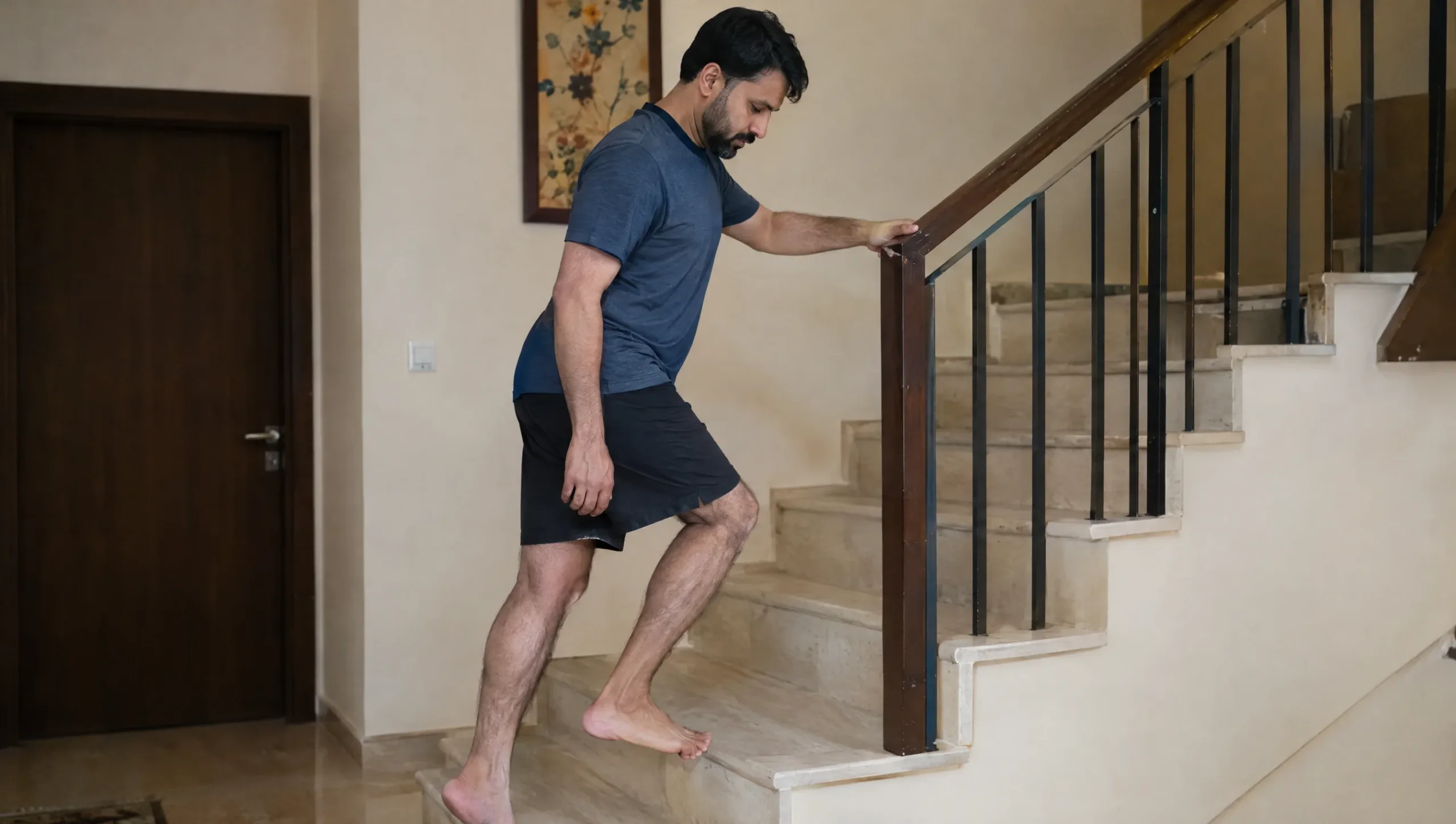
The following exercises are commonly used in early-to-mid stage Achilles tendinitis rehabilitation, but they are general education only. Please have a physiotherapist confirm these are appropriate for your specific stage of injury before starting, especially if you suspect a partial tear.
Seated or standing isometric calf holds involve pressing the ball of your foot into the floor or against a wall and holding for 30-45 seconds, repeated four to five times, which can be done even when the tendon is quite irritable. The classic Alfredson eccentric heel drop is performed by standing on a step with your heels raised, then slowly lowering both heels below the step edge over a count of three to four seconds, typically for three sets of fifteen repetitions, twice daily, progressing from both legs to one leg as tolerated.
Calf stretches, holding a gentle stretch against a wall for 30 seconds on each side, help maintain ankle flexibility between exercise sessions. As symptoms settle, we add single-leg balance work and controlled heel raises off a step to rebuild the strength and control needed for running or sport. A short note on prevention: gradually increasing training load (no more than roughly 10% per week), replacing worn-out shoes, and keeping calves strong even after you feel recovered are the three habits most likely to stop this injury from coming back.
Frequently Asked Questions

How long does Achilles tendinitis take to heal with physiotherapy?
Most mild-to-moderate cases improve noticeably within 6 to 12 weeks of consistent physiotherapy, while cases that have been present for several months before treatment starts can take 4 to 6 months of structured rehabilitation. Starting treatment early, rather than waiting it out, is the single biggest factor in a faster recovery.
Can I keep running with Achilles tendinitis?
In many mild cases, a physiotherapist can help you modify your running rather than stop completely, such as reducing distance, avoiding hills, and running on softer surfaces, while starting loading exercises. If pain changes your running form or lingers for more than a day afterward, it is safer to pause running until a physiotherapist assesses your tendon.
Is it better to rest or exercise an irritated Achilles tendon?
Complete rest alone often makes tendons weaker and more vulnerable once you return to activity. The current evidence-based approach is controlled, progressive loading, starting with gentle isometric holds and advancing to eccentric heel drops, guided by a physiotherapist who can adjust the program to your pain response.
Do I need an X-ray or MRI for Achilles tendon pain?
Most straightforward cases of Achilles tendinitis can be diagnosed through a physical examination alone, without imaging. An ultrasound or MRI is usually only needed if symptoms are not improving after a fair trial of physiotherapy, or if a physiotherapist suspects a partial tendon tear.
Achilles tendinitis responds very well to the right treatment plan, but the exercises and progression need to be matched carefully to your specific stage of healing. If you are in Rawalpindi or Islamabad and dealing with heel or calf tendon pain, our team at Physio Rehab Solution can assess your tendon, confirm the diagnosis, and build a week-by-week recovery plan designed around your activity goals. You can also read more in our related guides on shin splints recovery for runners and runner’s knee treatment, or browse our general physiotherapy FAQ for more answers.
Ready to get your Achilles tendon moving pain-free again? Book an in-person assessment with Dr. Iqra Kiran at Physio Rehab Solution in Rawalpindi today. Call or WhatsApp +92 321 4287773 to schedule your appointment, or visit physiorehabsolution.com to learn more about our services.