If you have ever been asked by a physiotherapist or doctor to “rate your pain from zero to ten,” you have already used a simplified version of the Visual Analog Scale, or VAS. It is one of the most widely used pain measurement tools in clinical practice and research. The VAS pain scale calculator below lets you score your current pain level in seconds and understand exactly what that number means for your treatment plan. At Physio Rehab Solution in Rawalpindi, we use VAS scoring with nearly every patient who walks through our door, because a single consistent number lets us track whether your pain is actually improving session to session, rather than relying on guesswork or memory. This guide explains how the VAS pain scale calculator works, how it compares to other pain scales, how to interpret your score, and when a number on a screen is not enough and you genuinely need an in-person assessment.
Table of Contents
What Is the VAS Pain Scale?
The Visual Analog Scale was developed decades ago as a simple way to turn something as subjective as pain into a number that clinicians and researchers could compare, track, and discuss. In its original paper form, it is a straight ten-centimeter line with “no pain” written at one end and “worst pain imaginable” written at the other. The patient marks a point on the line that represents their current pain, and the distance from the “no pain” end is measured to produce a score, usually expressed on a zero-to-ten scale in digital and clinical shorthand.
What makes the VAS useful is not its complexity but its lack of it. It does not ask you to choose between awkward verbal categories like “moderate” or “severe.” Instead, it lets you place your pain anywhere along a continuous line, which captures small changes that a five-point or even an eleven-point word scale can miss. This is part of why the VAS pain scale calculator format has remained a standard in orthopedic clinics, physiotherapy practices, post-surgical recovery tracking, and clinical drug trials for conditions ranging from arthritis to lower back pain.
It is worth being clear about what the VAS measures and what it does not. It measures pain intensity, meaning how strong the pain feels right now, not pain location, pain quality (burning, aching, sharp, throbbing), or how much the pain is limiting your daily function. Those require separate assessment tools, which a physiotherapist will typically combine with your VAS score during a full evaluation.

Try the VAS Pain Scale Calculator

Use the slider below to mark where your current pain sits between “no pain” and “worst pain imaginable.” This digital version of the VAS pain scale calculator works exactly like the paper line scale used in clinics, except it does the measuring for you. Your result stays private in your browser and is not recorded or sent anywhere.
Visual Analog Scale (VAS) Pain Calculator
No pain
Treat this as a quick self-check, not a diagnosis. A single VAS reading tells you how things feel right now; the more useful picture comes from tracking your score over several days or across physiotherapy sessions to see the direction it is moving.
VAS vs Other Pain Scales: NRS and Wong-Baker FACES
The VAS is not the only pain measurement tool in use, and it helps to know how it fits alongside the others you might encounter.
The Numeric Rating Scale (NRS) is the one most people are actually familiar with: a clinician asks you to simply say a number from 0 to 10 out loud, with 0 being no pain and 10 being the worst pain you can imagine. It is faster than the VAS because there is no line to mark, and research generally shows the two scales produce comparable results for most adults, which is why many clinics now use the NRS verbally and reserve the VAS for more formal tracking or research documentation.
The Wong-Baker FACES Pain Rating Scale uses a row of six cartoon faces ranging from smiling to crying, and is mainly used with children, older adults with cognitive impairment, or anyone who has difficulty with numbers or language. It trades precision for accessibility.
For more complex pain presentations, physiotherapists sometimes add the McGill Pain Questionnaire or condition-specific tools, which capture the quality and emotional impact of pain rather than just its intensity. None of these tools replace the others entirely; a good clinician picks the right tool, or combination, for the patient in front of them.
One more distinction worth knowing: researchers sometimes also use a Verbal Rating Scale (VRS), where you simply choose a word such as "none," "mild," "moderate," or "severe." It is the least precise of the group but the easiest to understand instantly, which is why you will still see it used in some triage and emergency settings where speed matters more than fine detail.

How to Interpret Your VAS Score
Most clinicians group VAS results into four rough bands, and the VAS pain scale calculator above follows the same convention:
- 0: No pain.
- 0.1 to 3: Mild pain, usually something you can work, sleep, and function through with minor discomfort.
- 3.1 to 6: Moderate pain, often starting to interfere with concentration, sleep quality, or specific movements.
- 6.1 to 10: Severe pain, typically disruptive to daily activity and worth addressing with a clinician promptly rather than waiting it out.
These bands are a helpful shorthand, but two things matter more than the raw number. First, pain perception is genuinely subjective and shaped by sleep, stress, mood, and prior pain experience, so your 6 and another person's 6 are not directly comparable. Second, and more clinically useful, is the change in your score over time. A drop from 7 to 4 across two weeks of physiotherapy tells us treatment is working even though "4" still sounds uncomfortable on its own. This is exactly why we repeat VAS scoring at the start of almost every follow-up session: the trend line is the real diagnostic information, not any single data point.

Why VAS Pain Tracking Matters in Physiotherapy
A physiotherapy plan is only as good as the feedback loop behind it, and VAS scoring is one of the simplest feedback loops available. Here is what it actually does in practice:
It creates an objective-feeling baseline. On your first visit, your physiotherapist records a starting VAS score alongside your range of motion, strength, and functional limitations. Every later session is measured against that same baseline.
It informs clinical decisions in real time. If your VAS score spikes after a particular exercise or manual technique, that is immediate information that the approach needs to change, the load needs to be reduced, or the tissue needs more time before progressing.
It supports documentation. Insurance providers, referring physicians, and your own treatment records benefit from a consistent, repeatable number rather than a vague note like "patient reports feeling better."
It keeps patients engaged. Watching your own VAS score trend downward over several weeks is motivating in a way that simply being told "you are improving" is not. It turns recovery into something measurable rather than something you have to take on faith.
In practice, a VAS score is almost never used alone. During a full evaluation at Physio Rehab Solution, we pair it with objective measures such as range of motion in degrees, manual muscle strength grading, and functional tests like how far you can walk before pain limits you, or how long you can sit before discomfort sets in. The VAS pain scale calculator gives us the patient-reported half of the picture; the physical examination gives us the observable half. Treatment decisions are made where those two halves agree, and when they do not agree, that mismatch itself is often clinically useful information worth exploring further.

Limitations of the VAS Pain Scale
As useful as it is, the VAS pain scale calculator has real limits, and being aware of them prevents over-relying on a single number.
It is entirely subjective, which means fatigue, anxiety, poor sleep, or even the time of day can shift your rating without your underlying tissue condition actually changing. It also does not capture pain quality: a 6 from a sharp, shooting nerve pain and a 6 from a dull, deep ache can point to very different underlying problems despite scoring identically. Language and cultural background can influence how people anchor their ratings to the extremes of the scale, which is part of why researchers often pair the VAS with other tools when precision matters. And critically, the VAS says nothing about the cause of your pain: it cannot tell you whether you are dealing with a muscle strain, a disc issue, nerve involvement, or something that needs imaging to diagnose properly.
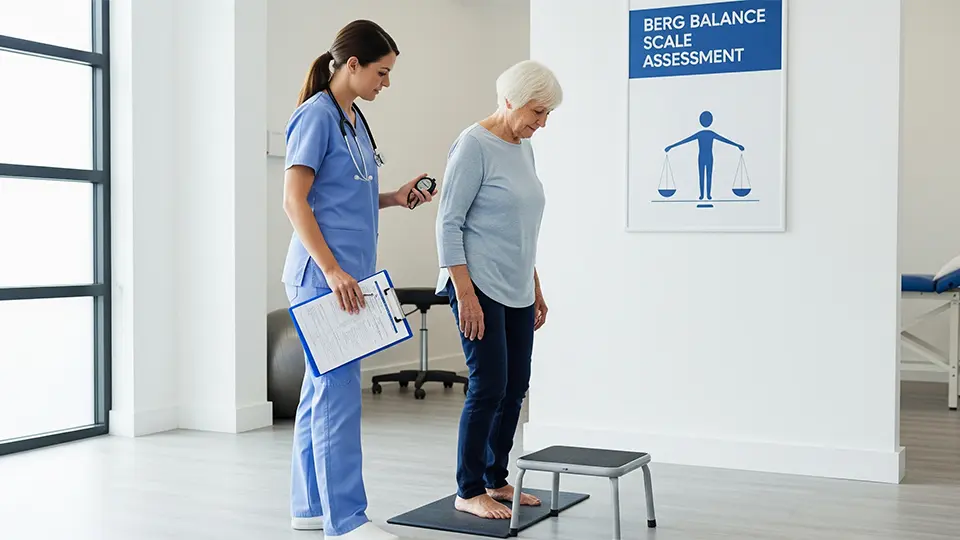
If your pain is severe, worsening, accompanied by numbness, weakness, fever, unexplained weight loss, or has lasted more than a few weeks, a number on a slider is not enough. That combination of signs is exactly when we recommend booking an in-person physiotherapy assessment so a clinician can examine the movement patterns, strength, and tissue behavior behind the score, not just the score itself. You can read more general physiotherapy guidance in our frequently asked questions, or compare how other standardized tools like the Neck Disability Index and the Berg Balance Scale are used alongside pain scoring in a full physiotherapy evaluation.
For a deeper look at how pain scales are validated in research, the comparative review by Hjermstad et al. published through the U.S. National Library of Medicine is a solid, evidence-based reference: Studies comparing Numerical Rating Scales, Verbal Rating Scales, and Visual Analogue Scales (PubMed/NIH).

Frequently Asked Questions About the VAS Pain Scale
Is the VAS pain scale calculator the same as the number a doctor asks for out loud?
It is closely related but not identical. When a clinician asks you to say a number from 0 to 10, that is the Numeric Rating Scale (NRS), a quick verbal cousin of the VAS. The VAS pain scale calculator traditionally uses a continuous line or slider rather than a spoken number, which can capture finer gradations, but in everyday practice the two are treated as interchangeable for tracking pain over time.
How often should I use a VAS pain scale calculator to track my pain?
For most musculoskeletal pain, once daily at a consistent time, such as first thing in the morning or at the end of the day, gives a clean trend without becoming obsessive about it. If you are actively in physiotherapy treatment, your physiotherapist will usually also record a score at the start of each session so progress can be compared visit to visit.
Can the VAS pain scale calculator diagnose what is causing my pain?
No. The VAS only measures how intense your pain feels; it cannot identify the underlying cause, whether that is a muscle strain, a joint issue, nerve irritation, or something else. A physiotherapist combines your VAS score with a physical examination, movement assessment, and your medical history to work out the actual source of the pain.
Why does my VAS score feel different from day to day even though my injury hasn't changed?
Pain perception is influenced by sleep quality, stress levels, activity load, and even weather or mood, not just tissue damage. Day-to-day fluctuation is normal and expected. What matters clinically is the overall trend across one to two weeks rather than any single day's reading.

A VAS pain scale calculator is a useful starting point, but it is not a substitute for hands-on assessment. If your pain has lasted more than a couple of weeks, keeps coming back, or is holding you back from work, sport, or daily life, the next right step is an in-person evaluation. Book an appointment with Dr. Iqra Kiran, DPT, at Physio Rehab Solution in Rawalpindi, and we will build a treatment plan around where your pain actually starts and how to track it properly from here. Call or WhatsApp +92 321 4287773 to schedule your visit, or get in touch through our website for more on our services.