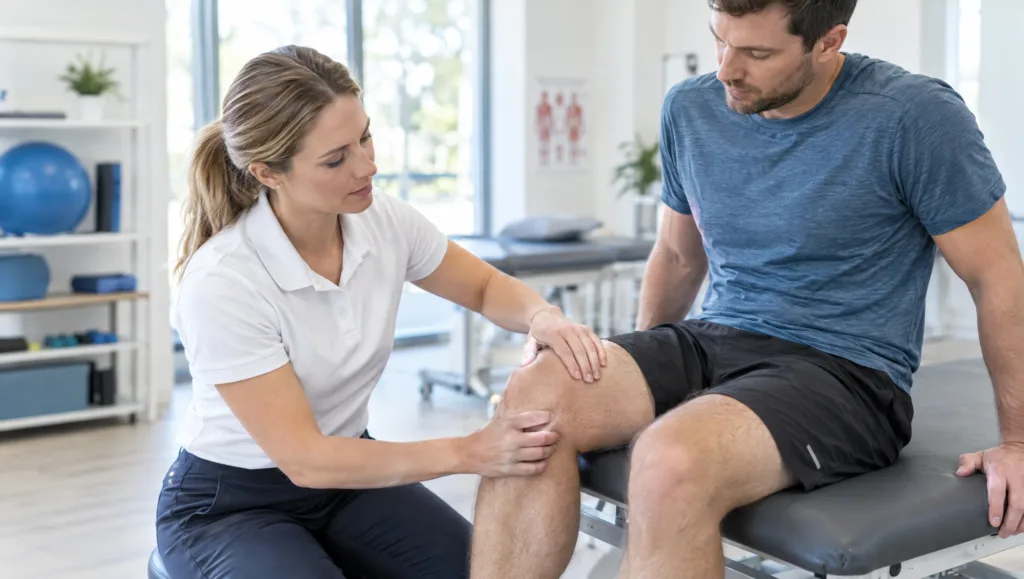
If you’re a runner who’s noticed a sharp, burning pain on the outside of your knee that flares up a few kilometers into every run, you may be dealing with iliotibial band syndrome — more commonly called IT band syndrome. IT band syndrome physiotherapy is one of the most effective, evidence-based ways to resolve this injury without taking months off from training. In this guide we’ll walk through what’s actually happening in your knee, why runners are so susceptible, how physiotherapists diagnose it, and the exact treatment approach that gets you back on the road pain-free.
Table of Contents
- What Is IT Band Syndrome?
- Why Runners Are Especially Prone to IT Band Syndrome
- Common Symptoms of IT Band Syndrome
- How Physiotherapists Diagnose IT Band Syndrome
- Physiotherapy Treatment for IT Band Syndrome
- A Realistic Recovery Timeline
- Stretches and Exercises for IT Band Syndrome
- Preventing IT Band Syndrome From Returning
- Frequently Asked Questions
What Is IT Band Syndrome?
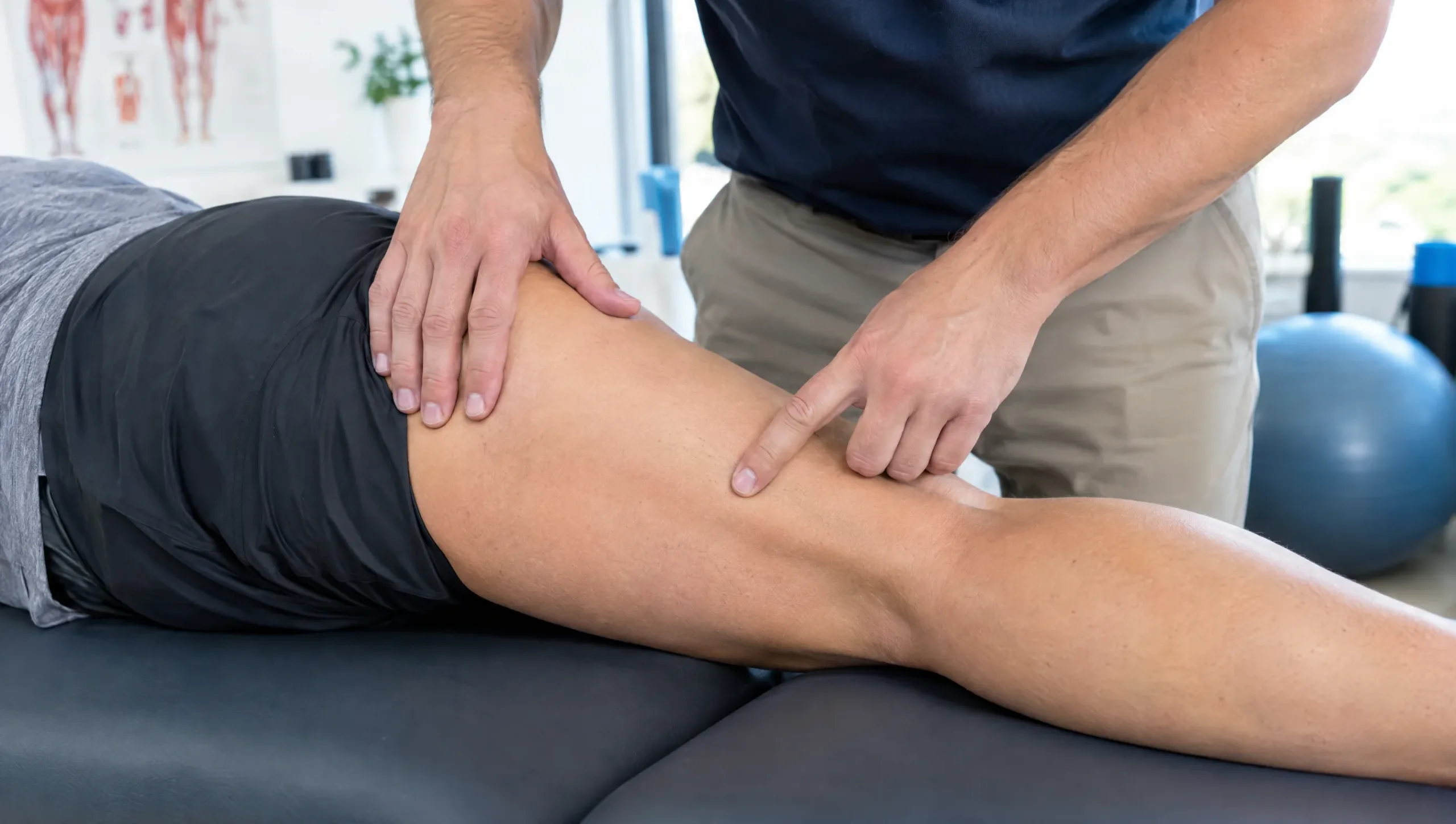
The iliotibial (IT) band is a thick strip of fascia that runs from the outside of your hip, down the outer thigh, and attaches just below the knee near a bony landmark called Gerdy’s tubercle. It works together with the tensor fasciae latae and gluteus maximus muscles to stabilize the hip and knee during walking and running.
IT band syndrome develops when this band repeatedly rubs or compresses against the lateral femoral epicondyle — a bony bump on the outside of your thigh bone — as the knee bends and straightens. This friction and compression happens most around 30 degrees of knee flexion, which is roughly the position your knee is in during the foot-strike phase of running. Over thousands of repetitions, the tissue becomes irritated and inflamed, producing the sharp outer-knee pain runners dread.
It’s worth noting that IT band syndrome is a distinct condition from patellofemoral pain syndrome, which is the injury most people actually mean when they casually say “runner’s knee.” If your pain sits at the front or center of the kneecap rather than the outside of the knee, our complete guide to runner’s knee may be a better fit for your symptoms.
Why Runners Are Especially Prone to IT Band Syndrome

IT band syndrome is one of the most common overuse injuries in distance runners and cyclists, and it rarely comes from a single cause. Instead, it’s usually a combination of training errors and biomechanical factors that overload the tissue faster than it can adapt. The most frequent contributors we see in the clinic include:
Sudden increases in mileage or intensity — ramping up weekly distance, hill repeats, or speed work too quickly doesn’t give the IT band time to adapt to the new load.
Downhill running — the eccentric control needed on descents increases friction at the lateral knee significantly more than running on flat ground.
Weak hip abductors — when the gluteus medius isn’t strong enough to control the hip, the thigh drifts inward (hip adduction) with every stride, increasing tension and friction through the IT band.
Running on a consistent camber — always running on the same side of a sloped road or track subtly changes the angle at the knee on one side with every single stride.
Worn-out shoes or a sudden change in footwear — reduced cushioning and support changes how load is absorbed through the leg.
Most runners don’t develop IT band syndrome from one single factor in isolation — it’s usually two or three of these stacking together, which is exactly why a physiotherapy assessment looks at your training log, your hip strength, and your running form rather than treating the knee in isolation.
Common Symptoms of IT Band Syndrome

IT band syndrome has a fairly recognizable symptom pattern, which is one reason it’s usually straightforward for a physiotherapist to identify. Watch for:
A sharp, burning, or stabbing pain on the outside of the knee that tends to appear at a predictable distance or time into a run — often the same point every time.
Pain that eases almost immediately when you stop running, only to return once you pick the pace back up.
Tenderness when you press directly over the bony bump on the outside of the knee.
Discomfort when walking down stairs or hills, which loads the knee in the same compressed position that aggravates the band during running.
Occasionally, a snapping or clicking sensation as the band moves over the bone with each stride.
If you’re also experiencing swelling, significant night pain, or instability in the knee, it’s worth having a physiotherapist rule out other causes before assuming it’s IT band syndrome.
How Physiotherapists Diagnose IT Band Syndrome
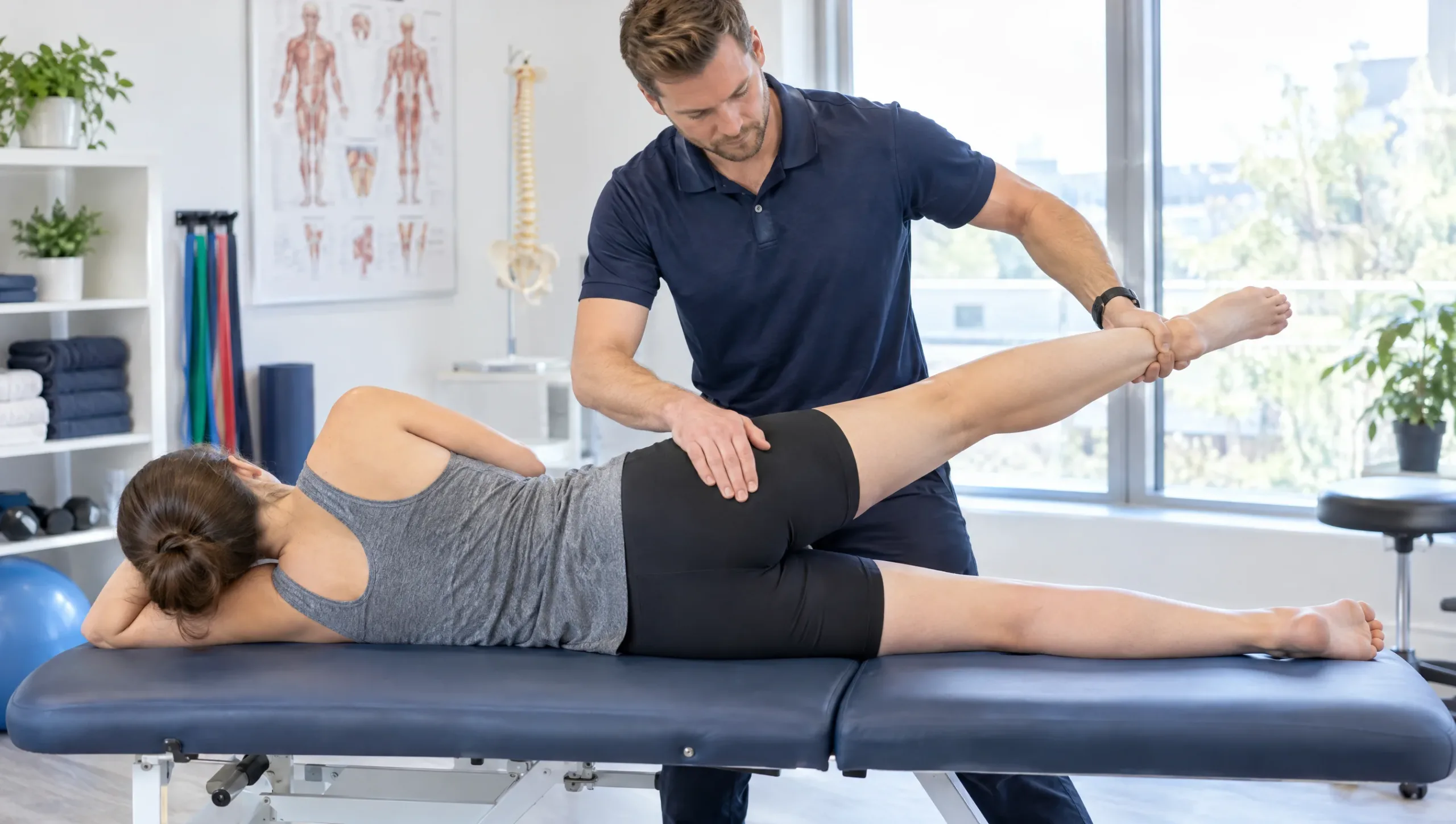
Diagnosis almost always starts with a detailed history — your training volume, recent changes in mileage or terrain, footwear age, and exactly where and when the pain shows up. From there, a physiotherapist will typically:
Palpate the lateral femoral epicondyle to reproduce your familiar pain and confirm the exact location of irritation.
Perform special orthopedic tests such as the Ober’s test (assessing IT band tightness) and Noble’s compression test (reproducing friction pain at roughly 30 degrees of knee flexion).
Assess hip and core strength, particularly the gluteus medius, since weakness here is one of the most common underlying drivers of the condition.
Review your running mechanics, often with video or treadmill gait analysis, to spot excessive hip adduction, crossover gait, or overstriding.
Imaging such as ultrasound or MRI isn’t usually needed for a first presentation, but may be recommended if symptoms persist despite several weeks of appropriate treatment, or if the diagnosis is unclear.
Physiotherapy Treatment for IT Band Syndrome
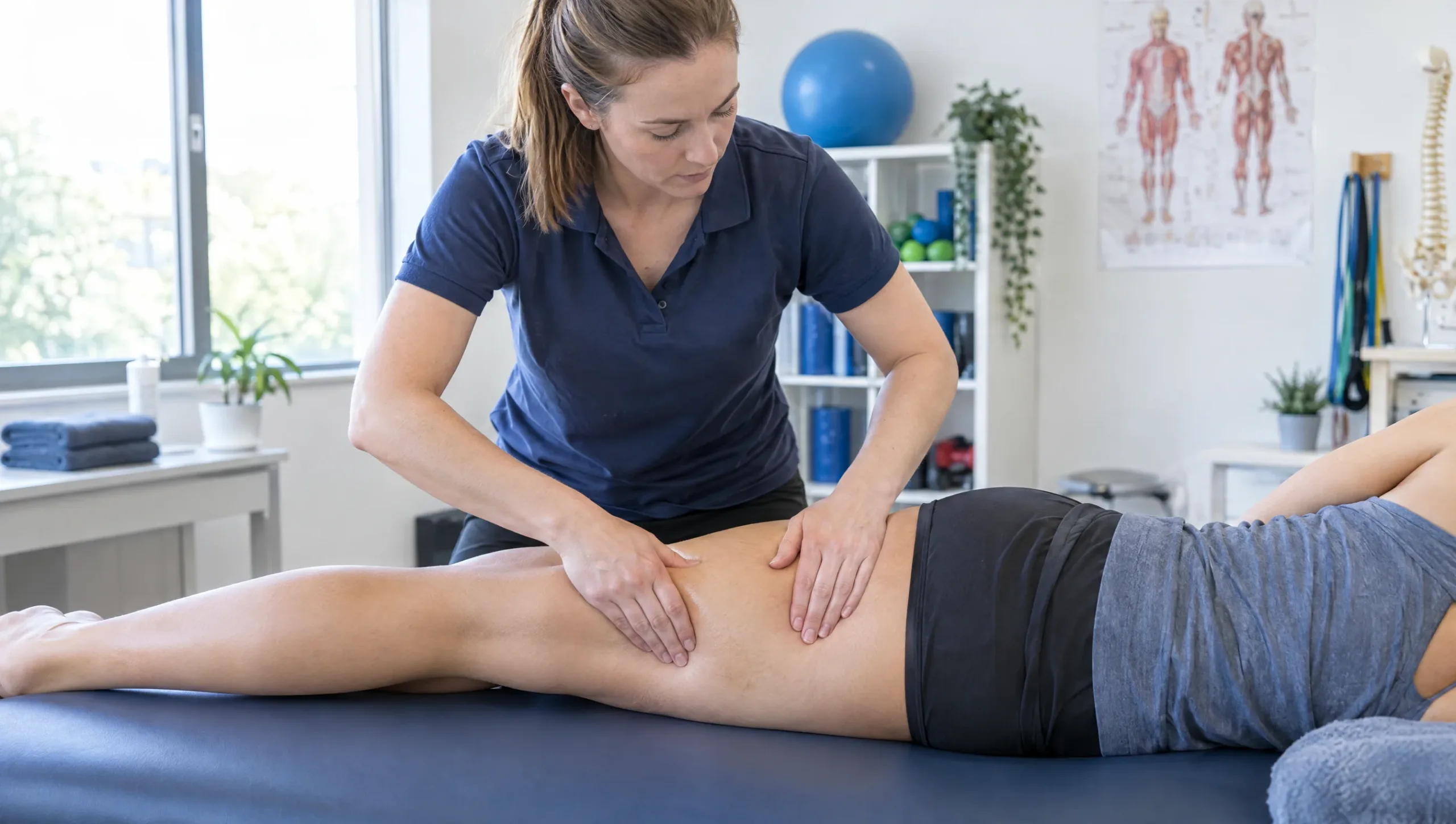
Effective IT band syndrome physiotherapy rarely means simply “rest until it stops hurting.” Complete rest can calm the pain temporarily, but it does nothing to fix the strength and mechanical deficits that caused the problem in the first place, which is why so many runners find the pain returns the moment they resume training. A well-built physiotherapy plan usually combines several of the following:
Activity modification, not complete rest — reducing mileage, swapping some runs for cross-training like swimming or cycling, and temporarily avoiding downhill routes while still allowing pain-free movement.
Manual therapy — soft tissue mobilization, myofascial release, and sometimes dry needling to the tensor fasciae latae, glutes, and quadriceps to reduce tension feeding into the IT band.
Targeted hip strengthening — building capacity in the gluteus medius and gluteus maximus so the hip controls the leg properly during the stance phase of running, directly addressing the most common root cause.
Gait retraining — cueing small changes such as a slightly wider step width or reduced hip drop, which research has shown can meaningfully reduce IT band load.
Taping techniques — kinesiology or McConnell taping can offload the irritated tissue and allow some runners to train with less pain while the underlying strength work takes effect.
A structured return-to-run protocol — a graded plan that reintroduces mileage, hills, and speed work in a specific order, rather than returning to your old routine all at once.
According to the Cleveland Clinic, most cases of IT band syndrome respond well to this kind of conservative, physiotherapy-led management, and surgery is rarely needed.
What makes this approach different from simply stretching and icing the knee is that it treats the IT band pain as a symptom of a hip-control problem, not the problem itself. Runners who only ever treat the local pain tend to see it return within a season; runners who also rebuild hip and glute strength are far more likely to stay pain-free long term.
A Realistic Recovery Timeline

Recovery time depends heavily on how early the problem is addressed and how closely the underlying strength and mechanical issues are treated, not just how the pain feels day to day.
Mild, early-stage cases treated promptly with activity modification and physiotherapy often settle within 2 to 4 weeks.
Moderate cases, where pain has been present for several weeks or months, typically take 6 to 8 weeks of consistent rehab before a full return to running volume.
Chronic or recurrent cases, especially where hip weakness or training errors were never corrected, can take 3 months or longer, and often need a more thorough overhaul of training habits.
The single biggest factor we see derail recovery is rushing back to full mileage too soon. A conservative rule of thumb is to increase weekly running volume by no more than about 10% at a time once you’re pain-free, and to reintroduce hills and speed work last.
Stretches and Exercises for IT Band Syndrome

These exercises target the hip weakness and tissue tightness most commonly linked to IT band syndrome. They’re a useful starting point, but they work best as part of a program built around your specific assessment findings.
Side-lying hip abduction — lying on your uninvolved side, lift the top leg slowly with control, keeping the hip from rolling backward.
Clamshells — knees bent, lying on your side, open the top knee like a clamshell while keeping your feet together, targeting the deep hip rotators and glute medius.
Single-leg glute bridges — build glute strength and single-leg control, both critical for stable running mechanics.
Lateral band walks — a resistance band around the knees or ankles while stepping sideways, directly loading the hip abductors.
Standing IT band stretch — cross the affected leg behind the other and lean your hip away from a wall for a gentle stretch along the outer thigh.
Foam rolling the quads, glutes, and TFL — the IT band itself is very dense fascia and doesn’t “release” easily under a roller, but rolling the surrounding muscles can meaningfully reduce overall tension.
Start with low reps and controlled movement, and have a physiotherapist check your form before adding resistance — poor technique on these exercises can reinforce the same compensation patterns that caused the injury.
Preventing IT Band Syndrome From Returning

IT band syndrome has a frustratingly high recurrence rate, mostly because runners go back to exactly the training habits that caused it once the pain fades. A few habits make a real difference:
Progress weekly mileage gradually rather than in sudden jumps, especially after a race or a break from training.
Keep a standing hip and glute strength routine going two sessions a week, even once you’re pain-free — strength gains fade quickly once the targeted exercises stop.
Replace running shoes roughly every 500 to 800 kilometers, or sooner if you notice uneven wear.
Vary your running routes and direction where possible, rather than always running on the same camber or side of the road.
Warm up properly before faster sessions, and respect early warning signs — a return of that familiar outer-knee twinge is a cue to scale back, not push through.
This article is for general education and isn’t a substitute for an individual diagnosis. If your knee pain is severe, worsening, or not responding to a few weeks of self-management, it’s worth booking an in-person assessment with a physiotherapist to confirm what’s actually going on and build a plan specific to you.
Frequently Asked Questions
Can I keep running with IT band syndrome?
Often yes, in a modified way. Complete rest usually isn’t necessary — most physiotherapy plans reduce mileage, cut out downhill or banked routes temporarily, and substitute some sessions with pain-free cross-training like cycling or swimming while the underlying hip weakness is addressed. If running itself reproduces sharp pain even at an easy pace, that’s a sign to scale back further until a physiotherapist can guide a safer return.
How is IT band syndrome different from patellofemoral pain (true “runner’s knee”)?
IT band syndrome causes pain specifically on the outside of the knee, from friction and compression of the iliotibial band against the thigh bone. Patellofemoral pain syndrome, which many people informally call runner’s knee, causes pain at the front or around the kneecap and stems from how the kneecap tracks in its groove. They can have overlapping risk factors, like hip weakness, but the treatment emphasis differs.
Does foam rolling actually help IT band syndrome?
The IT band itself is dense, low-elasticity fascia that doesn’t lengthen or “release” much under a foam roller. That said, rolling the surrounding muscles — particularly the quadriceps, glutes, and tensor fasciae latae — can reduce the overall tension feeding into the band and often provides short-term symptom relief, even if it isn’t fixing the underlying cause on its own.
How long before I can return to full running volume?
Mild cases often return to full training within 2 to 4 weeks of consistent physiotherapy and activity modification, while moderate or chronic cases can take 6 to 12 weeks. The safest marker isn’t a calendar date but a graded, pain-free progression — increasing weekly mileage by roughly 10% at a time and reintroducing hills and speed work last.
Ready to deal with your IT band pain properly? If outer knee pain is holding back your training, Dr. Iqra Kiran, DPT and the team at Physio Rehab Solution in Rawalpindi can assess your hip and running mechanics and build a physiotherapy plan to get you back to pain-free running. You can also read more answers to common questions in our physiotherapy FAQ. Book an appointment at our Rawalpindi clinic by calling +92 321 4287773.